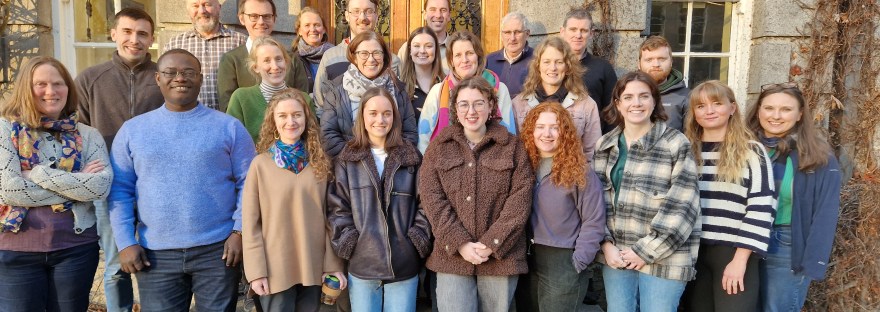
Ireland’s pollinator research community came together this month to share their latest updates and research at the annual Irish Pollinator Research Network (IPRN) meeting. Researchers descended on the Botany building from Trinity, Maynooth University, UCD, Galway University, and Teagasc for the one-day meeting. Over the day, 15 talks were given, and a few of the highlights are presented below.
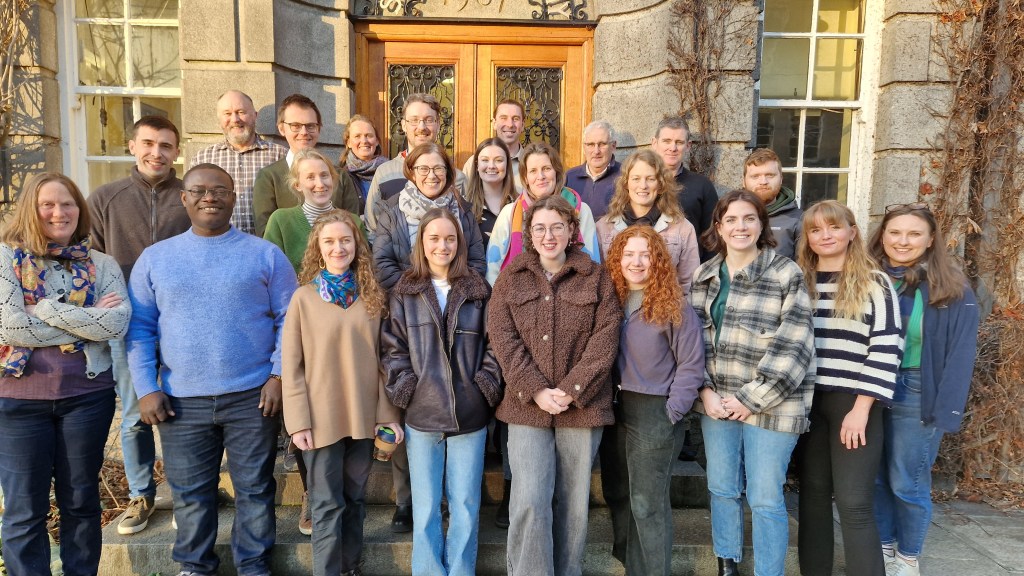
IPRN members at the 2024 meeting at Trinity College Dublin
Interesting cross-disciplinary research was presented by Engineer Adam Narbudowicz (Senior Research Fellow at Trinity), whose team, funded by Trinity’s Kinsella E3 multidisciplinary scheme and working with Jane Stout and Cian White, has been developing a small radar sensor capable of distinguishing between several pollinator species. This generated much excitement at the thought of how many different uses a technology like this could have.

Adam Narbudowicz presents work on radar sensors
Tara Dirilgen (Assistant Professor at Maynooth) presented a fascinating talk on why bee scientists need to diversify their pesticide research. With a systematic review methodology, she, and a team at UCD, found that bee researchers had overly invested in studying just one species, honeybees and just one group of pesticides, neonicotinoids.
In contrast, the conference had no such biases. There was a wonderfully diverse set of talks including research on solitary bee nesting habits (Colm O’Leary, a PhD student at UCD and Teagasc), rare and cryptic bumblebees (Lydia Thompson and Ciara Shivnen, PhD and undergraduate students at UCD), and cocoa pollination in Ghana (Richard Boakye, recent PhD student at UCD).

Richard Boakye presents his work from his PhD on implications of cocoa expansion in Ghana
Kate Harrington (PhD student at Trinity) presented some of the preliminary results from her survey of pollinators in newly planted Irish woodlands (part of the FOREST research project), and Sophia Couchman (PhD student at Maynooth) shared some of her findings about how pollinator abundance varies with the variable Irish summer weather.
Alexandra Valentine (PhD student at Galway) updated the meeting on her work on the Irish honeybee, and her work on morphological and molecular traits of Irish bees. Whilst Darren O’Connell (postdoc at UCD) presented a meta-analysis done as part of the National Apiculture Programme on the challenges associated with the treatment of Varroa using different methods. Julia Jones (Assistant Professor at UCD) presented findings from a study in the UK on non-native and native commercial bumblebee imports that demonstrated little introgression of non-native genes into wild populations. Julia announced that they have been awarded funding for the next phase of the National Apiculture Programme, and called for researchers to join their efforts.
Dara Stanley (Assistant Professor at UCD) did an excellent job of summarising the findings of three major research projects: PROTECTS, SusPoll and PoshBee, all of which examined the exposure and impacts of pesticides on pollinators. Some of the key findings were 1. The most widely used pesticides in Ireland are herbicides and fungicides; 2. There is little known about these products on bees; 3. Pesticide residues are found in crops, wild plants, and the pollen collected by bees; 4. Herbicides can influence molecular processes and functioning like digestion and learning in bumblebees; 5. Non-neonicotinoid insecticides can have sub-lethal impacts on pollen collection by bumblebee colonies and on solitary bees; and 6. Although Irish pollinators are most active in the middle of the day, we should think about mitigating pesticide use in a broader context than just spraying at different times.
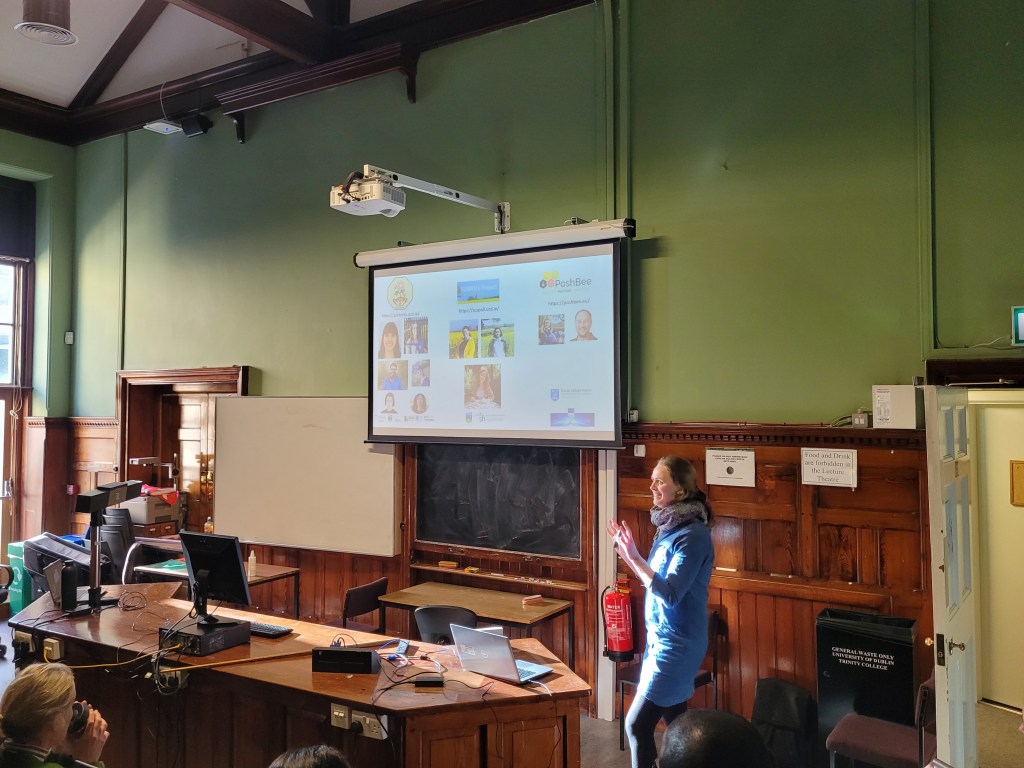
Dara Stanley summarising the pollinator-pesticide work from 3 recently completed collaborative research projects
Following this, Jess Knapp (Assistant Professor at Trinity) presented a major output from the PoshBee project, showing that despite strict risk assessment and regulatory process in Europe, pesticides are still having negative impacts on bumblebees, particularly in intensive agricultural landscapes. This research, which was the biggest standardised experiment ever performed on bumblebees, was recently presented to EFSA, the body that assesses pesticide risks and advises the European Commission, emphasising the importance of research for informing policy and regulation.
In an exciting development for Irish pollinator research, Sarah Larragy (postdoc in Trinity) introduced the community to the new EU funded project, Restpoll. As Sarah explained, Restpoll is an EU wide project looking to understand how to restore habitats to help pollinators. The project kicked off at the end of 2023 in Sweden, so we’ll update you in future years on what they find.
Jane Stout (Professor in Trinity) closed out the conference with a discussion on translating research into impact. The group identified the stakeholders who should be informed by research, and the methods that are used for research dissemination. Challenges to bridging the gaps between research and practice/policy were discussed, and the Irish Pollinator Research Network as a whole was challenged to take our research out of the lab and into society, and to help each other to do that.

Jane Stout leading a discussion on engaged research for impact.
About the Author: Ed Straw is an IRC postdoc in Jane Stout’s research group at Trinity College Dublin.

 Campus Buzz