By Moya Owens, Research Assistant with the ANTENNA Project, Trinity College Dublin
Pollinator researchers descended onto UCD campus this year for the 9th annual Irish Pollinator Research Network (IPRN) meeting, hosted by Dr. Dara Stanley and Dr. Julia Jones. Researchers from eight universities and research institutions presented their research to the group, with approximately 40 members in attendance. This year’s meeting was one of the largest, showing that while pollinators are in decline, there is a large group of dedicated people working hard to reverse this.
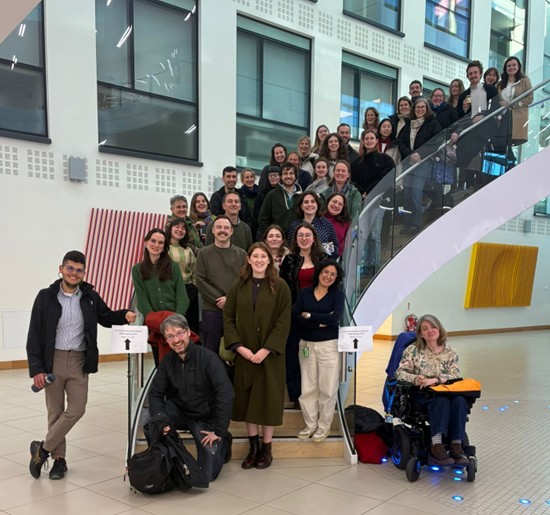
Figure 1 This year’s attendants at IPRN 2026!
There were a whopping 27 talks given, covering a wide range of topics including updates from the Farmer Moth Monitoring Programme, the relationship between soil and soil-dwelling pollinators, the use of technology in pollinator monitoring, solitary bee hotels, farmer behaviours surrounding pollinator conservation, and how solitary Andrena bees are responding to environmental changes. Presentations were given by researchers at all stages, including students (undergraduates to PhD candidates!), research assistants, post-docs and PI’s. In addition to this, three new PhD projects were introduced; Beth Bryan (Teagasc/University College Dublin) introduced her research, which is assessing the effects of agroecology on pollinator diversity, which forms part of the SAFER project. Another new PhD project includes Ponds for Pollinators, which was introduced to us by Clémentine Sitoleux (Teagasc/Trinity College Dublin). Her research will investigate how farm ponds support pollinators and biodiversity on Irish farmlands. We were also introduced to research being carried out by Lena Deck (University College Dublin), who will be looking at the impacts of pesticide residues in soil on soil-dependent pollinators. Some very interesting new research being carried out over the next few years – watch this space!
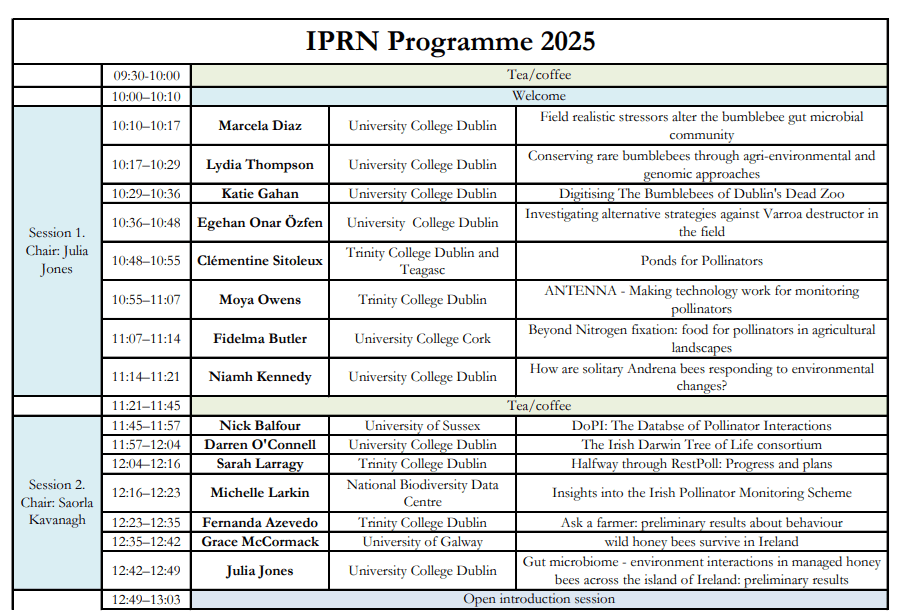
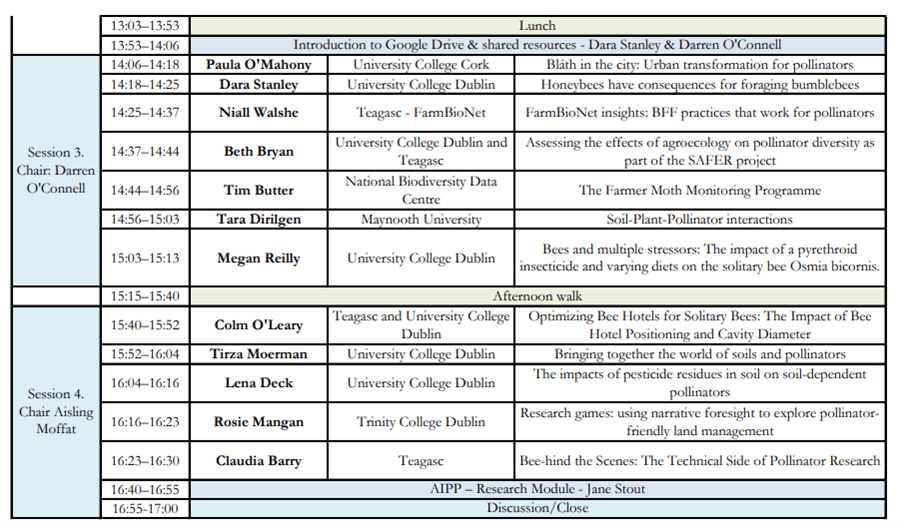
Figure 2 The schedule for the day.
Research themes
The one-day meeting was jam-packed with a wide range of presentations. Pollinator research is well and truly thriving in Ireland, with a wide variety of research taking place. Below is a quick summary of the themes of research spoken about at the meeting – shout out to all the speakers this year!
| Theme | Speaker |
| Bee gut microbiome | Marcela Diaz Julia Jones |
| Honeybee health | Egehan Onar Öfzen |
| Managed vs wild pollinators | Grace McCormack Dara Stanley |
| Land management and pollinators | Clémentine Sitoleux Fidelma Butler Sarah Larragy Fernanda Azevedo Paula O’Mahony Niall Walshe Beth Bryan Rosie Mangan |
| Soil and pollinators | Tirza Moerman Lena Deck Tara Dirilgen |
| Solitary bees | Megan Reilly Colm O’Leary Niamh Kennedy |
| Pollinator monitoring | Michelle Larkin Tim Butter |
| Databases and collections | Katie Gahan Nick Balfour Darren O’Connell |
| Technology for monitoring pollinators | Moya Owens |
| Technical work | Claudia Barry |
Table 1 A list of research themes and speakers at this year’s IPRN meeting.
Some highlights from the day
Katie Gahan (UCD) presented work on her undergraduate thesis, where she spent the summer digitising the bumblebee collection at the National Museum of Ireland. She emphasised the importance of depositing lab specimens to the museum, along with all information relevant to the sample. This prompted a discussion amongst the group about the importance of depositing samples once research is complete – an area that many attendants felt we could improve! Another fascinating talk was given by Niamh Kennedy, a PhD student at UCD, who presented updates on her research assessing how solitary Andrena bees are responding to environmental changes. Niamh has chosen the Netherlands as her case study area, due to its dramatic change in land use. She is looking at how historical and contemporary Andrena flavipes differ, and whether land use impacts this.
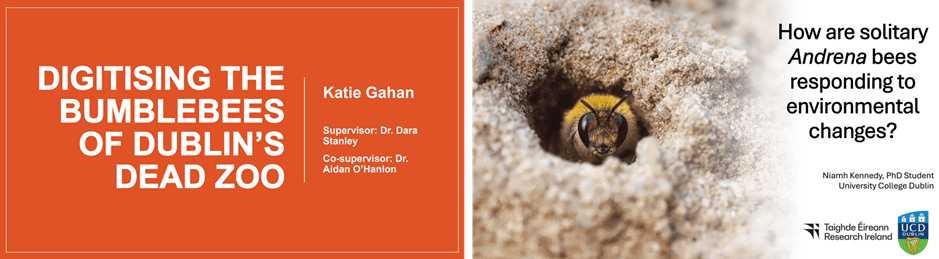
Figure 3 Katie Gahan’s undergraduate thesis research (left); Niamh Kennedy’s PhD research (right).
After a quick tea break and some delicious pastries, Nick Balfour from the University of Sussex informed us of DoPI, an open-access pollinator-plant interaction database which contains over 400,000 records detailing 800,000 interactions from 395 publications! Dr. Sarah Larragy (TCD) then gave us insight into the EU-funded RestPoll project, which has reached its halfway point. She updated us on the Irish 2025 field work season (you can read our field work blog here) and the success of RestPoll’s second Irish Living Lab workshop, which you can read more about here. Sarah also emphasised the importance of continuous engagement within the IPRN group and how increased collaboration would not only benefit the pollinators, but the researchers too!
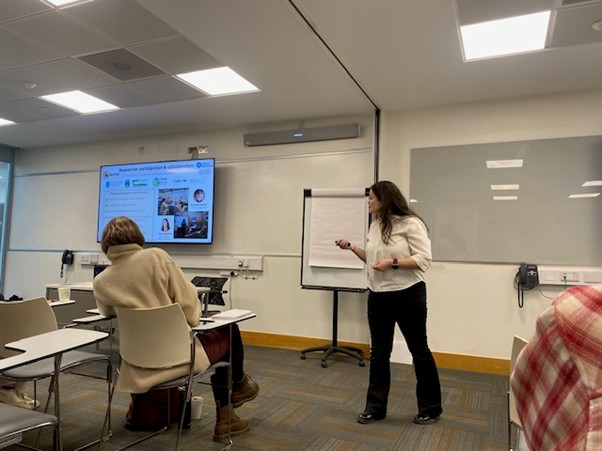
Figure 4 Dr. Sarah Larragy providing updates on the RestPoll project.
PhD candidate Fernanda Azevedo (TCD) presented updates on her project Ask a Farmer, which focuses on the socio-ecological factors affecting pollinator conservation in agricultural landscapes. Fernanda developed a behavioural framework to identify motivations/limitations to the adoption of pollinator conservation and restoration practices by farmers. She presented preliminary results from her work surrounding this, highlighting that feeling part of a community is important to farmers, while their appreciation for nature is a definite motivator in the adoption of pollinator-friendly practices. In contrast, she found that the administrative burden from engaging in payment schemes can discourage farmers from taking up pollinator conservation measures. She then discussed her next steps, which involves conducting individual interviews with farmers this year. Engaging with and listening to farmers is such an important aspect in many areas of pollinator research, and it was great to hear of research directly involving them and hearing their thoughts on what potentially encourages vs discourages farmers from tackling pollinator declines.
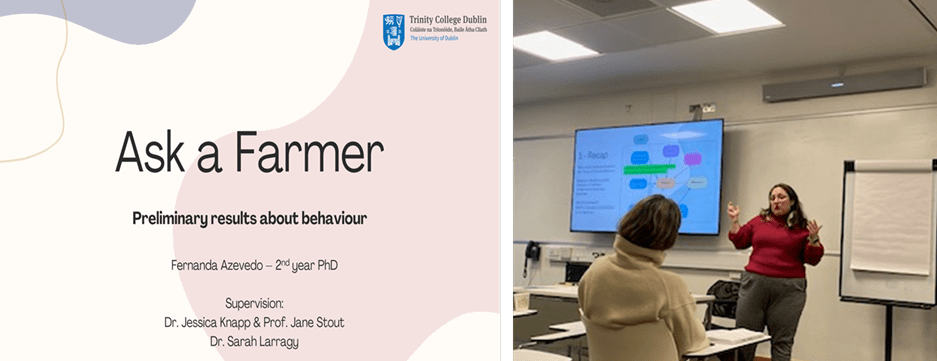
Figure 5 Fernanda Azevedo presenting her research Ask a Farmer.
After a wonderful lunch and chats at the Pi Café in the O’Brien Science Centre, members returned for the afternoon sessions. Paula O’Mahony (UCC) kicked off the session detailing her masters thesis titled ‘Bláth in the city: urban transformation for pollinators’. The aim of her project is to investigate the impact of the no-mow policy on plant-pollinator dynamics. You can find more information on Paula’s research here. Dr. Dara Stanley (UCD) gave a talk on the impact of managed honeybee colonies on foraging bumblebees, with research showing that beekeeping in the heathlands does impact bumblebee behaviour. Research found behavioural changes among bumblebees in areas with high honeybee activity. She highlighted that more research is needed in this area to truly understand the changes in bumblebee behaviour and whether this will have knock-on effects for their colonies. Tim Butter (NBDC) provided us with updates on the Farmer Moth Monitoring Programme, which is a farmer-led monitoring scheme that engages farmers in citizen science for pollinators. In 2025, he had 61 farmers sign up to the programme, with 59 sending data to him over the field season – a huge success, likely a result of the admin-free involvement and very frequent and informative correspondence with Tim!
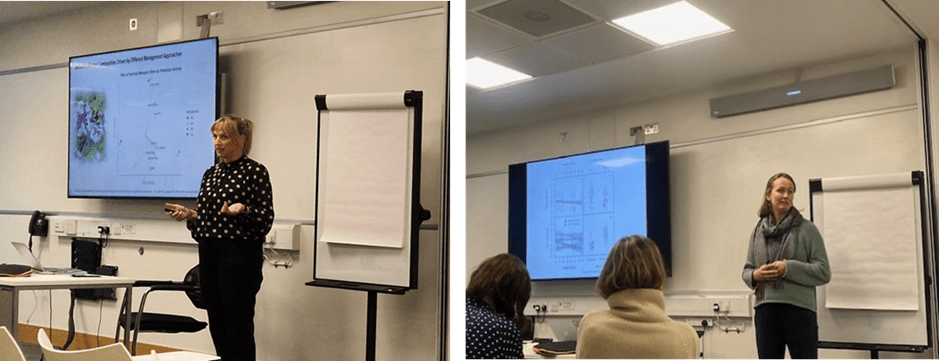
Figure 6 Paula O’Mahony (left) presenting her work from her masters thesis; Dr. Dara Stanley (right) explaining the consequences managed honeybees have on foraging bumblebees in heather habitats.
After a stroll around the UCD campus, we were back for the final session of the day. We heard from PhD student Colm O’Leary (UCD) on the optimisation of bee hotels for solitary bees, where he discussed the effects of height, cavity diameter and nest orientation on cavity nesting bees. We were also introduced to the ProPoll Soil project by Dr. Tirza Moerman (UCD), which aims to understand the relationship between soil and soil-dependent pollinators. To close out the day, Professor Jane Stout (TCD) spoke about Phase Three of the All Ireland Pollinator Plan (AIPP), which is due to launch in the Spring of 2026. This phase is structured around different modules, highlighting farmers, communities, businesses and public bodies. Jane focused on the Research Module at this year’s meeting, with discussion emphasising how important it is to engage with practitioners and the public in the research we are conducting. The aim of the research module is to lead the way in pollinator research and to contribute to solutions for policy and practice in Ireland and elsewhere. There was an agreement amongst the group on improving communication between researchers, with the aim of a more collaborative approach to research.
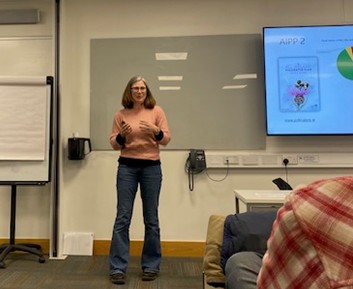
Figure 7 Professor Jane Stout with the final talk of the day, focusing on phase 3 of the AIPP.
Overall, the meeting this year really emphasised the importance of a collective effort in pollinator research. Pollinator research depends on collaboration as much as it does on data. By engaging and collaborating with each other, we can strengthen the impact of our research and work more effectively towards our shared goal of reversing the decline of our essential pollinators.
Many thanks to Sarah Larragy and Fernanda Azevedo for their editing contributions!

 Campus Buzz