by Kate Harrington, PhD student, FOREST project, Trinity College Dublin
The pollinator community of young woodland sites, planted in farmlands under the Native Woodland Scheme (DAFM, 2024), was explored in the summer of 2023. We used pan trap and transect surveys to record and capture bees and hoverflies , looking at both the edges and centres of the woodlands, and we also looked at pollinator activity and floral resources.
Pollinators, as might be expected, forage mainly on the edges of the woodlands. The Native Woodland Scheme prescribes the planting of flowering species around the edges which support our native pollinator species, and seem to be particularly important for solitary bees in the spring. The grassy edges, released from agriculture pressure, and unmanaged hedgerows, also contribute to the floral resources available for pollinators.

Bombus pratorum resting on a hazel leaf
With a range of sites of different ages, we were able to look at how the pollinator fauna changed across the development of a woodland from an open habitat to one with a closed-tree canopy.
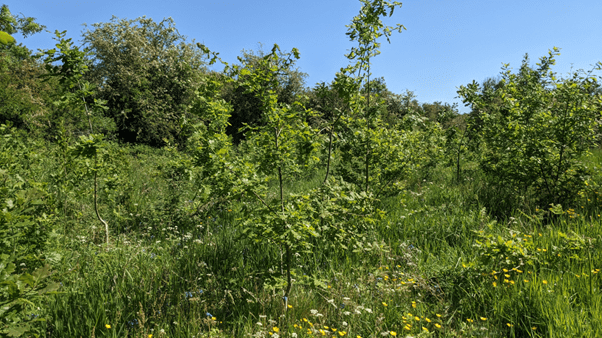
A young native woodland plantation
With a range of sites of different ages, we were able to look at how the pollinator fauna changed across the development of a woodland from an open habitat to one with a closed-tree canopy.
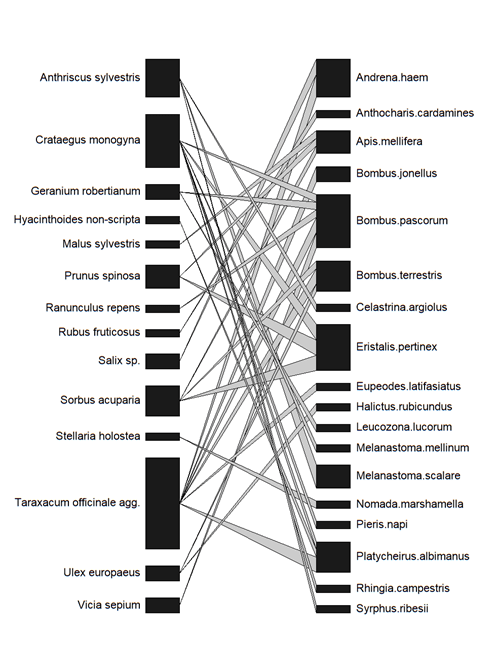
Native woodland spring plant-pollinator network
It has been suggested that functional groups such as pollinators may be particularly useful as ecological indicators. With the rush to plant native trees as a solution to the biodiversity and climate crises, monitoring the success of these restoration initiatives is crucial, and we may need to look beyond simple habitat metrics (Marshall, 2024). Our findings suggest that if we were to use pollinators as a monitoring metric for woodland sites, that bees may be a better indicator than hoverflies, as the latter respond more to landscape-level changes, while bees may better reflect any site-level changes.
DAFM. (2024). Afforestation Scheme 2023-2027 Document. April 2024. Department of Agriculture, Food and the Marine. https://www.gov.ie/en/publication/6e997-afforestation-scheme/
Marshall, C. A. M., Wade, K., Kendall, I. S., Porcher, H., Poffley, J., Bladon, A. J., Dicks, L. V., & Treweek, J. (2024). England’s statutory biodiversity metric enhances plant, but not bird nor butterfly, biodiversity. Journal of Applied Ecology, 1365-2664.14697. https://doi.org/10.1111/1365-2664.14697
Mola, J. M., Hemberger, J., Kochanski, J., Richardson, L. L., & Pearse, I. S. (2021). The Importance of Forests in Bumble Bee Biology and Conservation. BioScience, 71(12), 1234–1248. https://doi.org/10.1093/biosci/biab121

 Campus Buzz