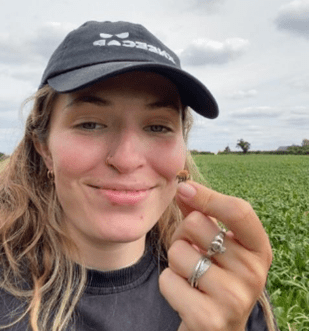
Written by Prof Jane Stout, co-founder of the All-Ireland Pollinator Plan and the Irish Pollinator Research Network (IPRN), and Research Module lead.
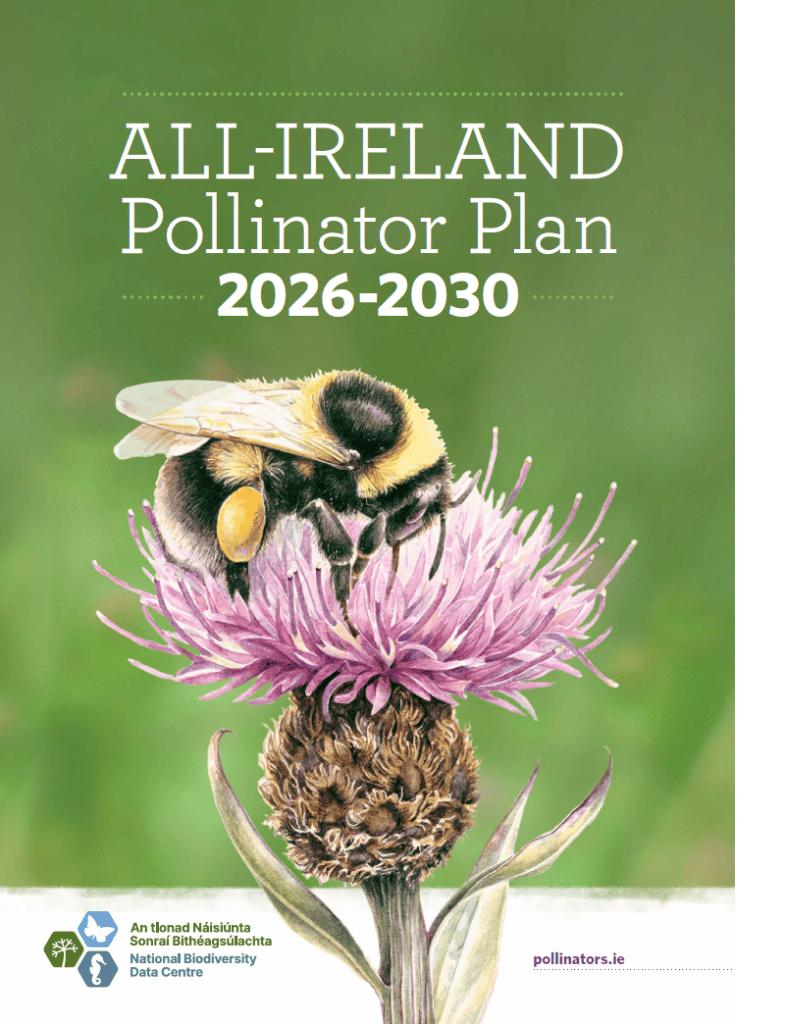
In July 2026, the third phase of the All-Ireland Pollinator Plan was launched. After two successful phases (2015-2020 and 2016-2025), this time, we wanted to build on the huge enthusiasm, engagement and commitment that now exists across the island of Ireland (see the 100 Tales of Hope, an incredible collection of stories from the second phase), but become more ambitious about reaching our 2030 targets of halting and reversing pollinator decline.
The Plan aims to bring together communities, farmers, businesses and public bodies to create pockets of nature every 200 meters across the island of Ireland and create a more biodiversity-rich landscape. Former Trinity College and RestPoll project researcher, Dr Sarah Larragy, delivered a wonderful webinar introducing the new Plan.
The 2026-2030 Plan is organised into Modules addressing key sectors and themes:
Protecting Farmland Pollinators: Supporting farmers with practical, evidence-based agricultural measures.
Creating Buzzing Communities: Mobilizing local towns, community gardens, and volunteer groups.
Local Authority & Public Body Engagement: Standardizing biodiversity practices across public land.
Transport Authority & Public Utilities Engagement: Managing roadside verges, railways, and utility corridors.
Business & Industry Engagement: Assisting companies in creating eco-friendly commercial sites.
Rare & Threatened Pollinator Species: Implementing specialized protection plans for at-risk species like the Great Yellow Bumblebee.
Mapping: Managing the tracking map database to view localized ecological corridors.
Research: Translating university and field research into layman-friendly practices.
Communications: Distributing resource toolkits, media outreach, and public campaigns like “No Mow May”
It is implemented by the National Biodiversity Data Centre, all overseen by the amazing Dr Una FitzPatrick and supported by an incredible team of project officers, including our own research group alumni, Dr Sarah Larragy and Dr Emma King.
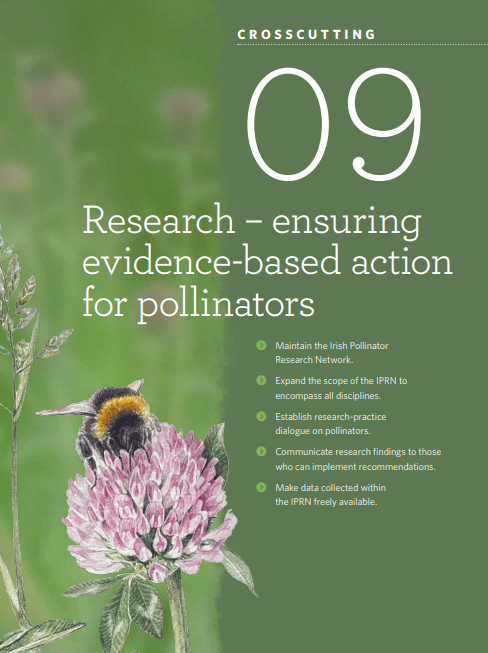
Key to our work in Trinity College, is the Research Module, which cuts across and links in with all the other modules. The role of the Research Module is to ensure that the actions taken for pollinators are evidence-based. This means that practical actions are more likely to work when implemented, which can save practitioners time and money. And it means that the discoveries made can inform relevant policy development.
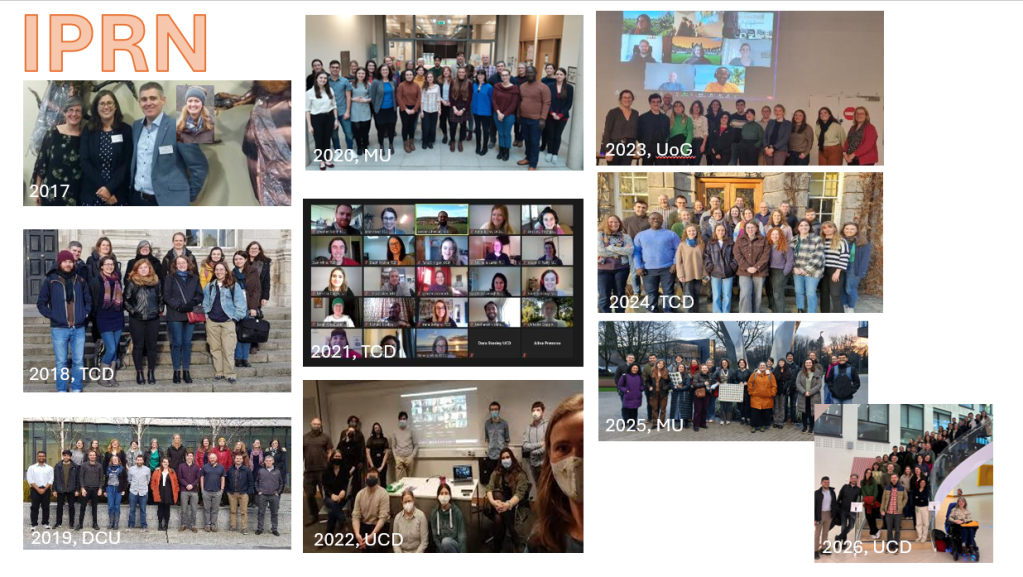
In 2017, we, the researchers, formed the Irish Pollinator Research Network (IPRN), which is a dynamic network of researchers addressing issues and providing the evidence base that supports the Plan. We have met as a group every year (see previous blogs from 2018, 2019, 2021, 2024, 2025, 2026), and maintain the ethos of the IPRN, which is to collaborate and share about our research – our findings, our approaches, our equipment and samples – and to support one another.
Ethos: Great science, great vibes!
The IPRN, including any subgroups, operates under an overarching ethos that prioritises positivity, constructive collaboration, and the cultivation of a welcoming, inclusive, and informal environment. It is a community where researchers are supported and encouraged to conduct excellent science while developing meaningful, collaborative connections with colleagues at all stages of their careers. The network aims to provide a space in which researchers can share ideas openly, engage in informal discussions, and do so in a collegial, enjoyable, and supportive atmosphere.
It’s a wonderful network and one I am very happy and proud to be part of. In the next phase, we are keen to emphasis that this research encompasses all disciplines, not just ecological ones, and already the network includes people working on a wide range of social, economic, and business issues relating to pollinator conservation.
In the next phase of the Pollinator Plan, we also aim to work harder to close the gap between research and practice. Although we have tried to keep up the information flow with our “Dispatches from Researchers” series of blogs (eg https://pollinators.ie/are-new-woodlands-good-for-nature/), in the next phase, we want to also have more face-to-face policy-practice dialogues. This enables us to explain what the research is suggesting (in terms of current status and trends, threats and solutions), and for stakeholders to tell us what they need to know in implementing pollinator conservation and restoration in the field. These research-practice dialogues will be organised in conjunction with the NBDC team.
Finally, we will continue to ensure that the data we collect on pollinators is not just used in the research, but is shared with landowners and other stakeholders and pollinator data/records will be submitted to the appropriate organisation (NBDC, CEDaR) and samples will be lodged in appropriate collections (museums).
Personally, it’s so wonderful to see a thriving pollinator research community across the island of Ireland, working together to understand the problems and help provide insight for the solutions. As researchers, we can’t reverse pollinator decline by ourselves – we need to work with other stakeholders across all sectors and in all organisations. And that’s what we want to do…
Jane Stout is Professor of Ecology in the Discipline of Botany, School of Natural Sciences, Trinity College Dublin. She leads the Plant-Animal Interactions Research Group and is a founder member of the Trinity Business and Nature Hub.
May 20th marked World Bee Day, where the world celebrates the tiny pollinators that play a huge role in our lives. Bees are one of the most important members of our ecosystems and provide an important ecosystem service in pollination. In Ireland, we have 100 bee species: 78 solitary bee species, 21 species of bumblebee and 1 honeybee. Sadly, bee populations are declining, both in Ireland and across the globe. Six out of the 100 bee species in Ireland are listed as critically endangered on the IUCN regional red list for Ireland. Celebrations like World Bee Day serve as a reminder of the importance of bees (as well as other pollinators!) to our ecosystems, and gives us an opportunity to highlight the crucial and necessary research that we are carrying out at Trinity to protect our pollinator species.
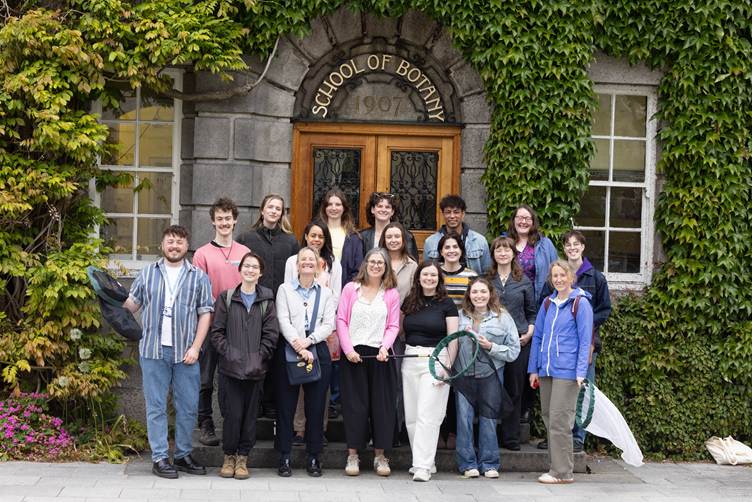
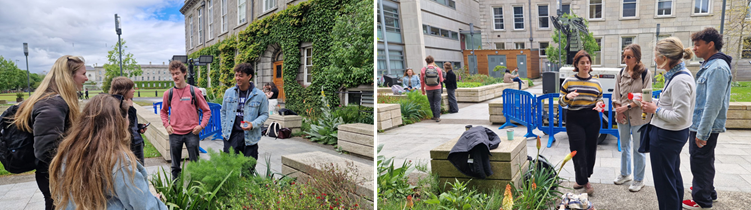
Figure 1 Celebrating World Bee Day at Trinity
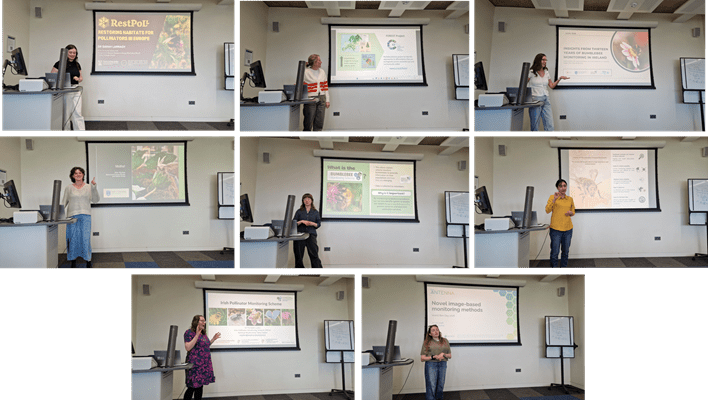
To celebrate World Bee Day 2026, we organised a Pollinator Workshop focusing on the monitoring efforts that are being carried out by researchers at Trinty and the National Biodiversity Centre. Prof. Jane Stout introduced the workshop, emphasising the importance of monitoring pollinators and the collection of data in order to have up to date trends on insect populations. This set the scene for a morning of flash presentations from researchers involved in pollinator monitoring (Fig. 3) which then led to some interesting discussion surrounding challenges, monitoring gaps and opportunities within monitoring schemes.
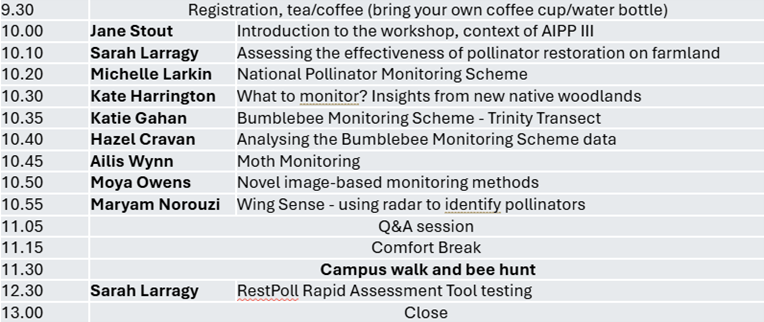
Figure 2 The agenda for the day
One of the main challenges with insect monitoring is surrounding variability – there are so many things to consider before even getting into the field to monitor! Insects are incredibly variable year to year and can be sensitive to environmental stressors which results in population fluctuations. Pesticides, habitat loss and climate change all impact our insect species and negatively impact populations. Additionally, the weather plays a huge role in insect activity and detection. Insects like warm, sunny weather conditions so choosing when to survey is crucial in order to detect insect activity (spoiler alert – Ireland is not the best at giving us sunny, dry weather). There are also gaps within monitoring schemes – monitoring methods don’t capture the whole picture, which is why projects like Wing Sense and ANTENNA can help fill these gaps. Novel technologies can capture richness over a wider spatial and temporal scale, improving our data and giving us a better understanding of population trends. We also discussed the new EU Pollinator Monitoring Scheme (EU-PoMS) which is being rolled out from 2027. Under the Nature Restoration Law, all EU Member States are required to reverse the decline in pollinators by 2030 – an ambitious task, but a good starting point that will hopefully a) Increase awareness surrounding the decline of pollinators and b) Lead to the implementation of effective measures that will improve pollinator diversity across Europe.
Figure 3 Researchers presenting their projects. L-R: Dr. Sarah Larragy, Dr. Kate Harrington, PhD student Hazel Cravan, Research Masters student Ailis Wynne, MSc student Katie Gahan, Dr. Maryam Morouzi, Dr. Michelle Larkin, Research Assistant Moya Owens
After the presentations and discussions, we took advantage of the dry weather and went on a bee hunt on campus. We found lots of insects flying about – honeybees (Apis mellifera), mining bees (Andrena spp.), white-tailed bees (Bombus lucorum agg.) and early bumblebees (Bombus pratorum). It was a great day celebrating all things bee – until next year!
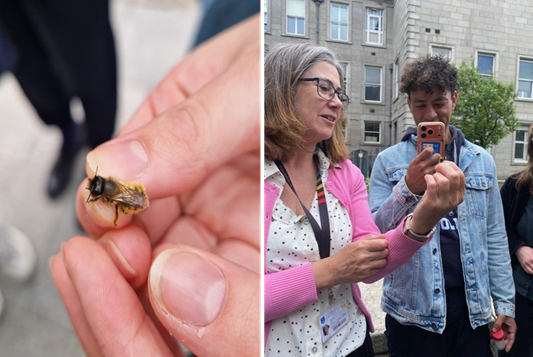
Figure 4 Enjoying learning about bees!
Figure 5 L: Red Mason Bee Osmia bicornis and R: Jane showing off a male Bombus pratorum
Dramatisation of the headline aside, Natural Capital Accounting (NCA) is a trending framework for ascribing value to ecosystems, that – in the eyes of this particular researcher – has a wide disparity in the potential outcomes it may lead to.
On one hand, we have a means to reshape our current economic systems in a manner that prioritises nature like the essential driving force of life it is. On the other, we have a streamlined methodology for powerful private interests to further commodify the natural world, widening existing wealth gaps and propagating the exploitation of developing countries. Standing at this crossroads, the scientists, economists, conservationists and humanists that recognise the powerful tool NCA might be, must face it for what it could be bastardised into.
“Concern for man himself and his fate must always constitute the chief objective of all technological endeavors… in order that the creations of our mind shall be a blessing and not a curse to mankind. Never forget this in the midst of your diagrams and equations.” – Albert Einstein.
Einstein uttered these words at a speech at the California Institute of Technology on 16 February 1931. Despite Einstein’s words, there still sometimes seems to exist a lack of consideration for externalities during the rigors of research. It’s of course a folly of a system that demands constant advancement and output, otherwise experts face redundancy, but still a flaw in the process none the less. The point I’m overexplaining is we must move cautiously and deliberately with frameworks connecting the living, natural world to monetary values.
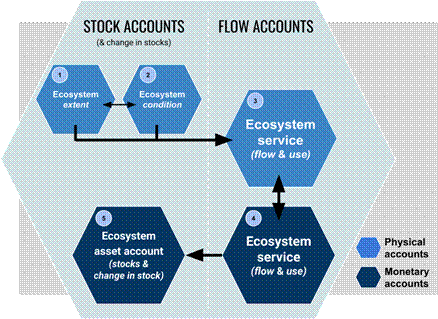
Three paragraphs in, perhaps it’s a decent time to define NCA, and the specific ecological-based aspects I’m referring to. Natural capital is simply all that comes from nature; soil, water, animals, plants, etc. The accounting bit refers to measuring the change in extent and condition of this natural capital, the stock as it’s called. In a more particular context, we have ‘Ecosystem Accounting’ which measures and tracks this stock over time, as well as how humans use it, or the flow of ‘ecosystem services.’ These services again are how humans use the ecosystems they exist in or adjacent to. Generally, they’re divided into four types: provisioning (food, timber), regulating (flood control, carbon sequestration), cultural (recreation areas, sacred sites), and supporting (photosynthesis, the water cycle). Fundamentally, human life and society do not exist without ecosystem services.
Figure from SEEA EA, conceptualising Ecosystem Accounting
At face value, this all sounds great. A system that seeks to monitor and track where ecosystems are, how they’re doing, and what they provide us. The issue lies not in the means or purported ends, but the potential perversion of its goals. Under the System of Environmental Economic Accounting (SEEA), there is an intention to reach a level where monetary values are calculated for ecosystem services and stock, albeit these monetary valuations are not ratified by the UN. The SEEA Implementation Strategy explicitly mentions intended uses for ecosystem accounting (EA) being to drive private and public investment for nature restoration, inform policy, and support current reporting requirements.
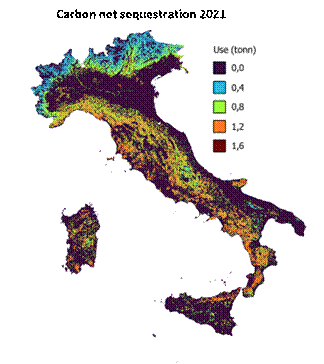
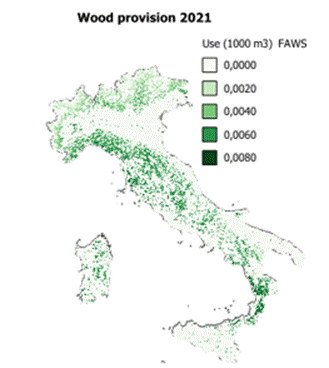
Figures from Mascolo et al. (2025) showing Natural Capital Accounts for Italy in 2021. (left) Net carbon sequestered by ecosystems. (right) Wood provisioning provided by forested areas.
This all sounds excellent, and there have been successful pilot projects and ongoing uses of SEEA EA. At a national scale in Italy, spatially explicit valuation of ecosystem services has improved the allocation of EU Common Agricultural Policy (CAP) subsidies, directing restoration funding to areas indicated for high returns (European Union, 2024; Mascolo et al., 2025). A multi-national SEEA EA pilot initiative helped quantify where forest degradation was avoided in Central and South America, as well as Southeast Asia, and even saw reform of forest repayment schemes in Mexico through the Natural Capital Accounting and Valuation of Ecosystem Services Project (NCAVES) (United Nations Statistics Division & United Nations Environment Programme, n.d.). Some studies even claim that the principles of NCA adopted in green accounting with private corporations have demonstrated improved financial performance (Tjandrakirana et al., 2024). It’s that last example, however, where the cause for concern can arise.
Accusations of politicising a discussion can be brought up when critiques of capitalism, and its impacts on the environment, are contended. Personally – as an independent individual whose views are my own and not any group or institution’s – I see enough categorical and empirical evidence supporting the statement that traditional capitalist systems, and the inherent growth dependency and profit maximization, are contradictory to current climate and biodiversity goals. While it’s encouraging to see organisations willfully partaking in more sustainable practices, it begs the question of whether these goals and practices are maintainable for profit-driven sectors.
Now, credit where credit’s due, that is in a sense the point of NCA and ecosystem accounting. Realign the priorities of financial systems so that profit is not the sole goal, but overall environmental health and human equity is an aim. In a vacuum, monetary systems are not destructive to ecology. Just as there’s exchanges of energy in a rich and dynamic trophic web, humans exchange currency in equally complex economies. That said, I’d safely assume most researchers in the field of NCA would all agree that the relationship between humanity, our economy, and nature needs to be overhauled in order to meet critical ecological goals. Where my previous sentiment was drawing alarms are the various stakeholders that would not view ecosystem accounting as means to change a system, but rather to further perpetuate their own economic power.
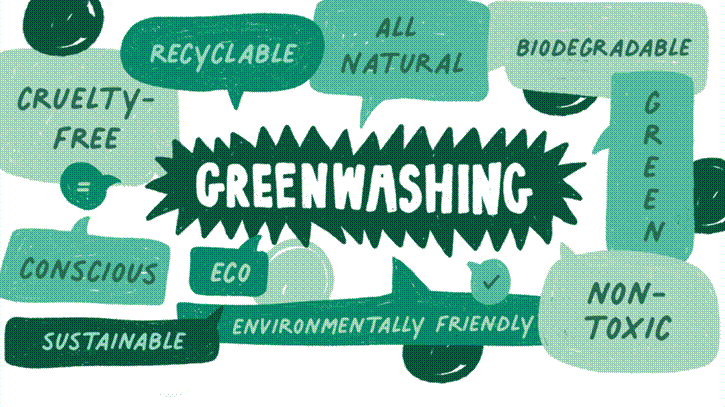
‘Greenwashing’ as it’s called is the new buzzword that really captures where a lot of my worries would lie. Thanks in part to ineffectual policy, or enforcement of existing legislation, countless companies in the developed world sell products labelled as “green” or “sustainable” with no true data to support it. Often the products are actually significantly damaging the environment. The easiest example, which the veil has been pulled back a little, is plastics and recycling. It’s very well documented that only a fraction of plastic products are truly recycled, and even the process of recycling them has its impacts, yet many companies still push “100% recyclable container” or “packaged made of 50% recycled plastic.” It’s predatory marketing practices harvesting a premium from environmentally conscious consumers.
Lets imagine greenwashing, but on a systemic scale rather than just the marketing and retail level. Weaponising NCA methods, companies whose industrial practice, regardless of any adjustments they can make, damage the environment (fossil fuels, strip-mining) could use ecosystem accounting to minimise and mask their impacts. One objective critique of NCA is, while there are standards in place, the operationalising of SEEA EA is largely site/stakeholder dependent. Accounts must be developed with goals in mind and vary region by region. Now, if a fossil-fuel company wipes out a protected habitat, there is not much data manipulation to be done to mask that, but what could be done is active minimisation of the wider impact. Ensuring condition and ecosystem service accounts downplay what this ecosystem provided, and perhaps even upscaling what other land the company may own has.
Yes, I’m jumping several steps ahead and making very large and brash assumptions, but that was precisely my point with the Einstein quote. His work, however indirect, contributed to the atomic bomb, and he even signed a letter with others warning the U.S. government of Germany’s atomic potential, a decision he would later voice regrets on learning more about how far they were. Despite that, America’s advancements in the 1930s/40s led the world to a nuclear era with unforeseen risks and consequences. Could physicists have treaded more carefully and brought us instead into an age of safe, nuclear energy? Similar questions, not quite as heavy questions could be asked when developing valuations for ecosystems. How do we, as NCA researchers, avoid a similar mistake and prevent for-profit private enterprises from misusing the principles of ecosystem accounting?
I’ve worked in the field for less than a year, so obviously have no answers myself. Moreover, there are countless distinguished experts in the NCA landscape who have had these same worries and asked the same questions. This is just the outward reflections of someone that has dove in and been inundated with a fascinating new perspective on quantifying and understanding humanity and our relationship with nature. Frankly, I worry it is too anthropocentric, plain and simple. It takes something that should be inherent, care for nature, and frames it in a transactional manner: nature good = humans good. If used as intended and responsibly, could NCA still contribute to our separation from nature? We frame it as capital – nature is an asset. I disagree; nature is us. We are innately part of the formula, not one side of an equation: nature good + humans good = Earth good.
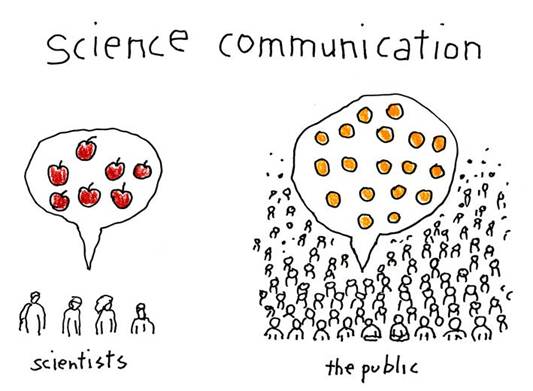
Science Communication cartoon by Tom Dunne
But, as a realist rather than idealist, ecosystem accounting is a practical solution regarding an already degraded relationship. Perhaps as it becomes mainstream, develops and improves, that inherent sense of caring for nature will be restored. In many ways, natural capital serves to speak on protecting biodiversity and improving sustainability in terms the people with significant impact understand. It’s the language of policymakers that fret about GDP, and the vernacular of corporations that cause the larger scale impacts. An ecologist’s understanding of something means little if it can’t be communicated to people making decisions. Creating ecosystem accounts is a form of communicating info many experts already know. On a macro-scale, it’s “laymen’s terms” for describing ecosystems, how they’re doing, and how important they are.
As we continue advancing Natural Capital Accounting, especially those of us developing new methods to quantify ecosystem services and their valuations, the responsibility is not abstract. I work on experimental recreation-related services accounts using relatively novel methods and a dataset with inherent bias. They offer an interesting perspective into understanding how people feel about and use an ecosystem. In the wrong hands, the accounts could easily be used to misrepresent the true sentiment of a community for a natural area. That’s a powerful tool that should be handled properly.
“The creations of our mind shall be a blessing and not a curse to mankind,” Einstein said. It’s not the ecosystem accounts alone that determine which contrivance of humanity it shall be; it’s the structures and systems that use it that decide. We can communicate nature as an asset but must make it clear that nature’s value is irrespective of its ability to serve people. Nature is valuable to humans. When we restore those last two words, we turn our relationship with nature into a transaction.
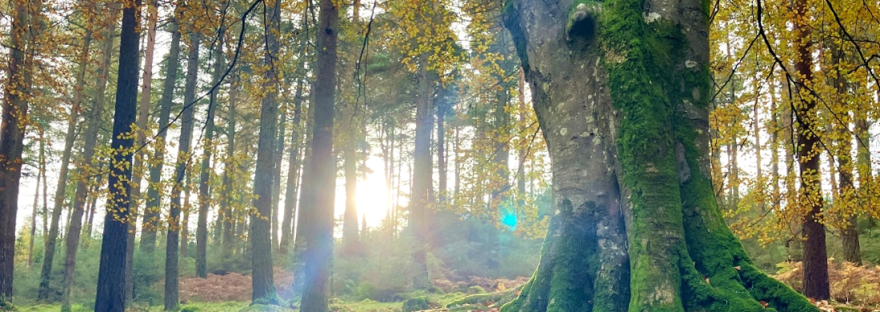
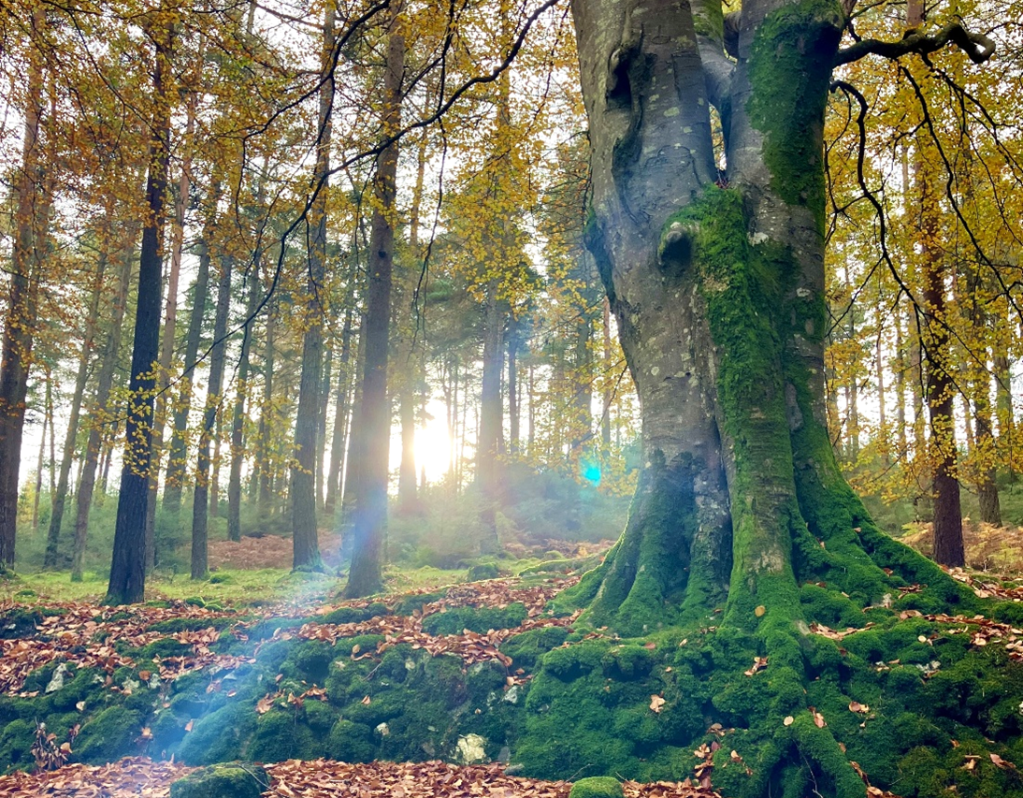
A photo of something ‘valuable’, from a walk in Co. Wicklow, Ireland
References
European Union. (2024). Regulation (EU) 2024/3024 of the European Parliament and of the Council of 27 November 2024 amending Regulation (EU) No 691/2011 as regards introducing new environmental economic account modules (SEEA EA). Official Journal of the European Union, L 3024.https://eur-lex.europa.eu/eli/reg/2024/3024/oj/
United Nations Statistics Division & United Nations Environment Programme. (n.d.). Natural Capital Accounting and Valuation of Ecosystem Services Project (NCAVES). SEEA UN Project Portal.https://seea.un.org/home/Natural-Capital-Accounting-Project
Tjandrakirana, R. D. P., Ermadiani, E., & Aspahani, A. (2024). The impact of environmental performance, green accounting, and corporate social responsibility (CSR) on financial performance. International Journal of Humanities, Education and Social Sciences (IJHESS), 4(3). https://doi.org/10.55227/ijhess.v4i3.1335
As we trudge our way through the dark and grey wintertime, it is no wonder we are reminiscing over sunny, insect-filled days. The People and Nature group saw a very busy season last summer, which brought us to and from farms all around the Co. Kildare area to conduct pollinator research! Our travelling troupe of bug catchers this summer included: • Dr Sarah Larragy (post-doc, RestPoll) • Fernanda Azevedo (PhD student, RestPoll) • Moya Owens (Research Assistant, ANTENNA) • Michalis Cristou (Biodiversity and Conservation MSc student) • Sarah Browne (Research Assistant) • Katie Gahan (Research Assistant) • Daan Mathijssen (Summer intern) • Sirus Rasti (Erasmus plus student)
Figure 1 The TCD RestPoll fieldwork team (a lovely bunch 😊 – thanks for all your help!)
This work contributed to two pollinator-related EU projects being conducted by members of the lab: • RestPoll: Restoring pollinator habitats across European agricultural landscapes (see Sarah’s blog here) • ANTENNA: Making technology work for monitoring pollinators (see Moya’s blog here)
RestPoll field work
As part of RestPoll, we are collecting field data to see if restoration measures for pollinators are effective. Many of our farms were previously involved in Protecting Farmland Pollinators and carry out many practices that are likely to benefit our busy bees and other pollinators. These biodiversity friendly actions include reduced hedgerow cutting, reducing or eliminating insecticide use, increasing the area of field margins and letting ‘weeds’ grow in unfarmed areas. To conduct our RestPoll field work, it was clear we were in for an intense season of insect counting (tough work but someone’s got to do it!). The traditional methods for surveying pollinators generally involve a transect walk – this is where one walks at a slow pace while keeping their eyes peeled for any bees, hoverflies or butterflies that pass through their path. Once we spot a pollinator, we note down the species and – should we spot them enjoying a floral treat – the plant species it visits. Over the summer, we conducted three rounds of pollinator transects and floral coverage surveys across 21 beef and tillage farms in the Co. Kildare region – and have the farmers’ tans to prove it! Antenna field work
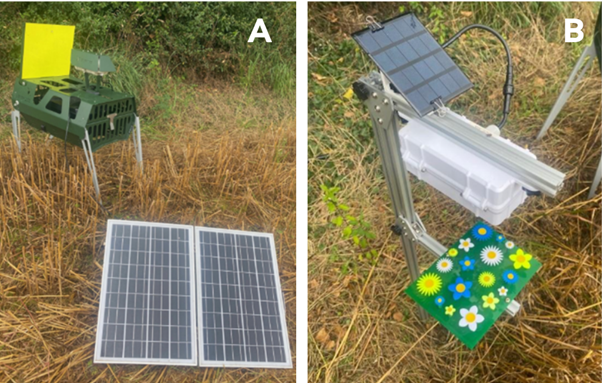
Overlapping with the RestPoll fieldwork was the much more technologically-advanced project, ANTENNA, conducted by Moya Owens (supervised by TCD alumni Dr Jessica Knapp, now based in Lund University!). Pollinator surveys have been conducted across 6 different countries in Europe, which included four rounds of surveys on five different sites in Co. Kildare. ANTENNA is investigating the feasibility of using fancy, solar-powered cameras to conduct pollinator monitoring. It aims to compare these high-tech approaches to traditional methods, like transecting and pan trapping. While transects are the traditional and usually the core methodology for any pollinator monitoring project, there are limitations such as not being able to see, or identify, everything you spot in the field. Oftentimes, you need to catch an insect to find out what species it is, and sometimes this requires careful examination under microscopes. Also, insects can often be difficult to catch. You may not think it, but chasing a butterfly down in a field full of boisterous cattle or waist-high wheat is a surprisingly humbling experience. Indeed, Sarah L. faced an unusually specific conundrum one day when a cow made off with her butterfly net, presumably for its own scientific pursuits. Other traditional methods, such as pan-trapping (multi-coloured buckets of soapy solution to catch insects) have the downfall of being a form of attractant, lethal sampling – an approach we are trying to reduce to mitigate negative effects on pollinator populations. Considering these limitations, technological approaches may be a solution to gathering much needed data on pollinator richness and abundance trends, as traditional methods are time-consuming and often require some level of lethal sampling. The cameras being tested in ANTENNA were a DIOPSIS 2.0 Insect Camera (Fig. 2A, Fig. 3) and a MiniMon camera (Fig. 2B).
Figure 2 Cameras being used in ANTENNA project include a DIOPSIS 2.0 Insect Camera (A) and a MiniMon camera (B).
The DIOPSIS camera is a fully automated system designed to detect, monitor and document insect populations, produced by Faunabit in The Netherlands. When an insect lands on the yellow screen, the camera captures high resolution images which are then uploaded to a server via Wi-Fi. Images are then processed using the image recognition model developed by Naturalis. In terms of the MiniMon camera, this was developed by the ANTENNA team, with the aim of being a user-friendly, cost-effective camera. Unlike the DIOPSIS camera, which monitors continuously, the MiniMon camera takes a burst of five pictures every minute. As shown in Fig. 1, there is a custom-made flower plate containing 3-D printed artificial flowers which attract insects. As well as recording insects we found, we also took note of floral coverage around each stake (2m radius).
Figure 3 Katie, Sarah B. and Moya did trojan work bringing these cameras around to different sites to conduct 6-hour bouts of surveying! Here they are on day one of successfully setting up the DIOPSIS camera.
Fun finds Over the course of the summer, we found some amazing insects, from painted lady butterflies (Vanessa cardui) to orange-tailed mining bees (Andrena haemorrhoa). Below we share with you our catches of the season! Research Assistant Sarah B.’s main memories from this season include finding the Common Tiger hoverfly (Helophilus pendulus; Fig 4 A) and peacock butterfly (Aglais io). Another stand out moment from the summer was finding 5 small tortoise shell (Aglais urticae) butterflies on field scabious (Knautia arvensis). Katie Gahan, another Research Assistant working with us this summer, enjoyed the field full of common spotted orchids (Dactylorhiza fuchsii).
Figure 4 Some of our fun finds during field work season! A. Common tiger hoverfly (Helophilus pendulus). B. Common spotted orchid (Dactylorhiza fuchsia). C. The large carder bumblebee (Bombus muscorum). D. Many tortoiseshell butterflies (Aglais urticae) foraging on field scabius (Knautia arvensis). E. Peacock butterfly (Aglais io). F. A new buff-tailed bumblebee (Bombus terrestris) queen.
“My catch of the season was finally seeing a Large Carder Bee (Bombus muscorum) for the first time! I caught a male on one of the last days of surveying, which was even more exciting as it meant I got to hold him since males don’t sting! After I caught this one, we saw a couple more flying along the transect which was super exciting. This was probably the best day in the field for me!” – Moya
Figure 5 Moya only delighted with the male Bombus muscorum she found!
“My fun find is not exactly rare, but it is very beautiful – it is the buff-tailed bumblebee queen. In this picture we see a new queen who is likely preparing for her upcoming winter diapause by stocking up on nectar and pollen. I studied buff-tailed bumblebees during my PhD, so I always enjoy seeing these beautiful (and huge!) queens during such a vital part of their lifecycle. I also really loved seeing so many butterflies out after several mild seasons – a particular favourite was the painted lady butterfly (Fig. 6)” – Sarah L. “I remember a day during our third round of surveys on Kepak farm where there were so many butterflies of different species out – it was really beautiful!” – Fernanda
Figure 6 A painted lady butterfly (Vanessa cardui).
A big thank you to the field work team for all their hard work this summer, it is so appreciated! And a sincere thank you to the farmers who let us come and count insects on their farms (and sometimes treated us to cups of tea!) – we couldn’t do this work without your support!
The Teagasc Farmland Biodiversity Group led by Dr Saorla Kavanagh, (Department of Environment, Soils and Land Use, Johnstown Castle) invites applications for a fully funded 4-year PhD. The PhD candidate will be registered at Trinity College Dublin and co-supervised by Professor Jane Stout, Professor of Ecology, School of Natural Sciences.
Project Background and Description Pollinator decline is a key threat to biodiversity conservation and the provision of ecosystem services. One third of Ireland’s bee species are under threat, with intensification and homogenisation of agricultural landscapes considered the principal driver. Diversifying habitats and understanding farmer attitudes towards biodiversity are key to halting further pollinator decline. Semi-natural habitats on the farm, for example, hedgerows, woodlands and trees, and wetland areas including ponds can provide valuable food and nesting resources for pollinators. In Ireland, there is little data on just how valuable ponds are for pollinators. Restoring biodiversity-friendly habitats and designing evidence-based actions that benefit biodiversity on the farm are crucial to meet the requirements of the EU’s Biodiversity Strategy and Nature Restoration Regulation, and to inform Policy for Agri-Environment measures. The aim of this PhD is to identify the benefits of ponds for pollinators, and gain an understanding of farmers’ knowledge of farmland biodiversity. Barriers around implementing biodiversity measures on the farm and solutions to these barriers will be identified.
Candidate Profile The ideal candidate will:
Hold at least an upper second class honours (or equivalent) Bachelor or Masters degree in, entomology, plant science, zoology, environmental science, or another related discipline
Have demonstrable analytical skills in the field and/or laboratory, and in data handling, analysis and presentation
Have the capacity/willingness to think critically and creatively, and apply multidisciplinary techniques to address hypothesis-driven questions
Work well in a multi-disciplinary team, and be able to work independently
Have excellent oral and written communication skills
Be willing to travel to field sites to conduct fieldwork and interact with landowners/farmers
Hold a full clean driving licence and able to drive in Ireland
Meet Trinity postgraduate entry requirements. See English language requirements here.
Funding This is a 4-year PhD project funded by the Teagasc Walsh Scholar Programme and covers an annual stipend of €25,000, and student fees of up to a maximum of €6,000. Project costs will be covered.
Application procedure Please send a CV and a 1-2 page personal statement detailing your interest in the project Tuesday, June 24th 2025 via email to Dr Saorla Kavanagh saorla.kavanagh@teagasc.ie quoting the reference number (2025037) in the subject field. Your CV should include the name and contact details of two references. In your personal statement, please explain both why you are specifically interested in this PhD project and why you are a strong candidate to undertake it. Interviews will take place (online) Friday, July 4th 2025.
Project start date: September 2025 Please send all inquiries to Dr Saorla Kavanagh Saorla.kavanagh@teagasc.ie