Pollinators are an important part of the world’s biodiversity, responsible for pollinating crops and wild plants, providing a valuable ecosystem service (Potts, 2010). Despite its importance, it is evident the global decline of the wild and domesticated species of pollinators (Potts, 2010). In Ireland, 30% of pollinator species are classified as threatened with extinction (Fitzpatrick et al., 2007), which jeopardises the country’s food production since the decline of pollinators means the decline of pollinator-dependent plant species (Potts, 2010).
78% of Europe’s flowering plants benefit from animal pollination, as do 71% of the crops that supply 90% of the world’s food. However, modern agriculture contributes to the decline of pollinator species through the application of agrochemicals and the conversion to highly productive monocultures (Russo et al., 2022). In a country like Ireland, where nearly 70% of land is managed for agriculture, and the agri-food sector is one of the country’s biggest industries, contributing in 2020 with 7% of the country’s gross income, plus 10% of exports (Government of Ireland, 2021), this is a pertinent issue.

Figure 1: Hedgerow managed for pollinators in an arable farm in Kildare.
The decline of bees not only impacts human life with agriculture and food security, but also the entire ecosystem, as without their action, there is a decline in ecosystem services. It means that, for example, wildlife does not have access to fruits and seeds, which interferes with nutrient cycling, seed dispersal and adaptation to climate change (All-Ireland Pollinator Plan, 2021). Furthermore, pollinator conservation has beneficial effects on pest control, soil erosion and microclimate regulation, which helps to mitigate the effects of the climate crisis and biodiversity loss (All-Ireland Pollinator Plan, 2021).

Figure 2: A green-veined butterfly (Pieris napi) on hedgerow Hawthorn (Crateagus monogyna).
According to Russo et al. (2022), it is extremely important to take conservation actions that protect the remaining high-quality habitats and improve the quality of degraded systems by identifying central organisms in the plant-pollinator network that can support the pair’s diversity and abundance.
A key challenge facing biodiversity conservation is human behaviour and the factors that govern its change (Marselle et al., 2020; Schultz, 2011; Knapp et al., 2020). However, Knapp et al. (2020) identified that when developing conservation strategies, natural scientists often disregard social factors affecting the human decision-making process to favour ecological evidence. This is particularly interesting because the implementation of conservation practices is majorly voluntary (Witzling et al., 2021) and, therefore, relies on a human decision.
Ignoring the social aspect of the conservation problem creates a gap between the ecological solutions and the implementation of these solutions by individuals, communities and society in general. This gap demands interdisciplinary approaches combining the understanding of the social pressures and norms that shape behaviour, the psychological reasons behind such behaviours, and the ecological solutions that can improve conservation behaviours.
Farms cover 67.6% of the Ireland’s area (EPA, 2022); therefore, taking into consideration farmers’ experience and knowledge of the land to adapt the already in place actions to a more comprehensive and user-friendly action plan is extremely important for a real impact in not only conserving the pollinators but also reversing the trend and restore pollinators in the country.
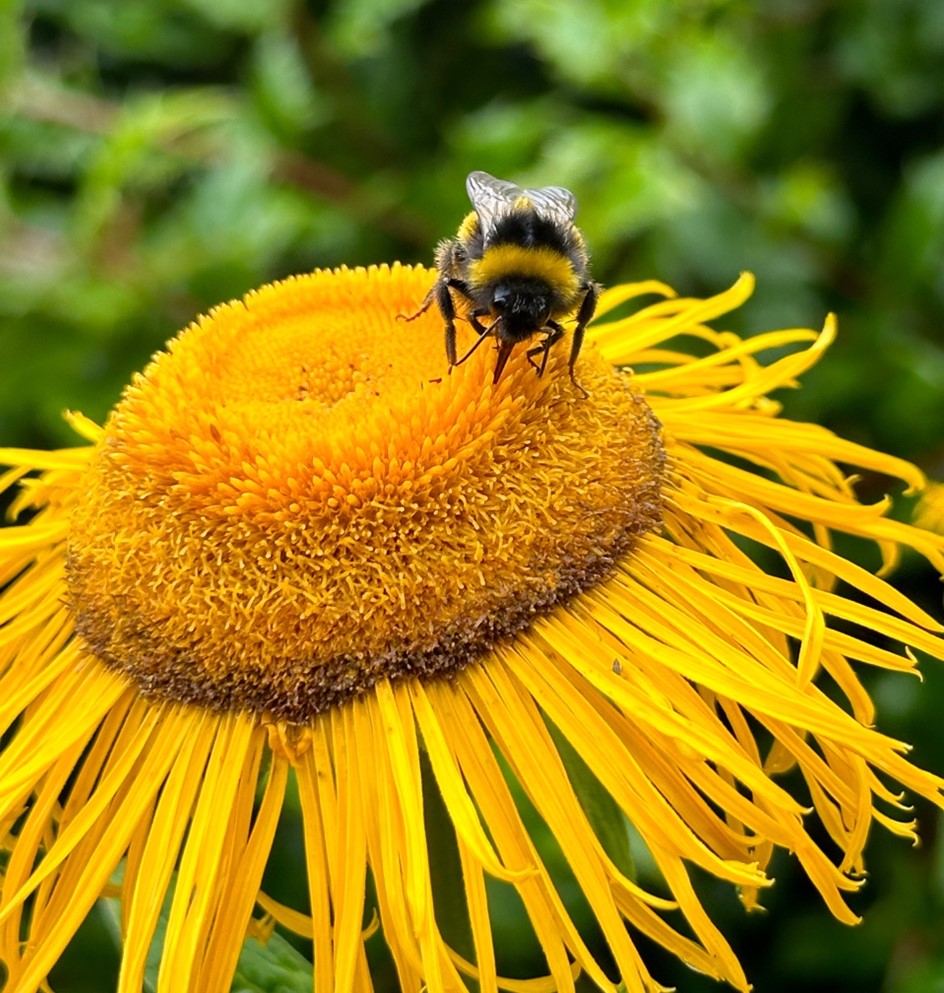
Figure 3: A bumblebee foraging on a Yellow Oxeye (Telekia speciosa).
Ask a Farmer is a PhD research project that will contribute to closing the gap between farmers’ actions and the ecological solutions to reverse pollinator decline using the All-Ireland Pollinator Plan (AIPP) as a case study, expanding the traditional, evidence-based conservation research and increasing the uptake and perpetuation of the AIPP. Adopting a holistic perspective that acknowledges the diverse and plural values individuals and societies attribute to nature (IPBES, 2022), and understanding the wide range of social factors (beyond finance). These social factors shape farmer motivation, capabilities and opportunities, influencing their behaviour around pollinator interventions and policies.
This will be possible by first developing a socio-psychological model to identify and quantify the social factors, including historical context, well-being, finance, social norms and identity, influencing the behaviour of the farmers. Then, the social effectiveness of the pollinator-friendly actions proposed by the AIPP (figure 4) will be tested by evaluating what is being done in real-life farms, integrating the recommendations and the experience of a lifetime in the field. Finally, developing a strategy that integrates social and ecological perspectives to increase the number of farmers adopters of the AIPP, ensuring a continuation of the program and enhancing pollinator conservation in Ireland and beyond.

Figure 4: Five pollinator-friendly actions proposed by the All-Ireland Pollinator Plan.
This May marks the beginning of the 2025 field season, during which the team started visiting the partner farms to collect ecological data on pollinators and interview the farmers about their perspectives on conservation actions, particularly pollinator conservation. A very ‘beezy’ summer ahead!

Figure 5: The team on our first day of the field season 2025. Dr. Sarah Larragy (front), Moya Owens (standing), and Fernanda Azevedo (sitting).
About the author:
Fernanda ‘Fern’ Azevedo is a first-year PhD researcher funded by the Trinity Research Doctorate Award, supervised by Professor Jane Stout, Dr. Jessica Knapp and Dr. Sarah Larragy. Her doctoral research builds on the themes she explored during her MSc in Biodiversity and Conservation at Trinity College Dublin, supervised by Dr. Jessica Knapp.
References:
All-Ireland Pollinator Plan (2021) All-Ireland Pollinator Plan 2021-2025. National Biodiversity Data Centre, Waterford. Available at pollinators.ie (Last accessed on 07/05/2025).
EPA (2022) Ireland’s Environment: Maps and Charts – Key Message 13: Land use.Available at: epa.ie (Last accessed on 07/05/2025).
Fitzpatrick, U., Murray, T.E., Paxton, R.J., Breen, J., Cotton, D., Santorum, V., Brown, M.J.F. (2007) Rarity and decline in bumblebees – A test of causes and correlates in the Irish fauna. Biological Conservation, 136(2): 185-194. DOI: 10.1016/j.biocon.2006.11.012
Government of Ireland (2021) Climate Action Plan 2021: Securing our Future. Dublin. Available at: gov.ie/pdf (Last accessed on 07/05/2025).
IPBES. (2022) Summary for Policymakers of the Methodological Assessment of the Diverse Values and Valuation of Nature of the Intergovernmental Science-Policy Platform on Biodiversity and Ecosystem Services (IPBES). DOI: 10.5281/zenodo.6522392
Knapp, J.L., Phillips, B.B., Clements, J., Shaw, R.F., Osborne, J.L. (2020) Socio-psychological factors, beyond knowledge, predict people’s engagement in pollinator conservation. People and Nature, pp. 204–220. DOI: 10.1002/pan3.10168
Marselle, M.R., Turbe, A., Shwartz, A., Bonn, A., Colléony, A. (2020) Addressing behaviour in pollinator conservation policies to combat the implementation gap. Conservation Biology. Vol 35 (2), 610-622. DOI: 10.1111/cobi.13581
Potts, S.G., Biesmeijer, J.C., Kremen, C., Neumann, P., Schweiger, O., Kunin, W.E. (2010) Global pollinator declines: trends, impacts and drivers. Trends in Ecology & Evolution. Vol.25, 6, 345-353. DOI: 10.1016/j.tree.2010.01.007
Russo, L., Fitzpatrick, Ú., Larkin, M., Mullen, S., Power, E., Stanley, D., White, C., O’Rourke, A., & Stout, J. C. (2022). Conserving diversity in Irish plant–pollinator networks. Ecology and Evolution, 12, e9347. DOI: 10.1002/ece3.9347
Schultz, P.W. (2011) Conservation means behavior. Conservation Biology, 25 (6), 1080–1083. DOI: 10.1111/j.1523-1739.2011.01766.x
Witzling, L., Wald, D., Williams, E. (2021) Communicating with farmers about conservation practices: lessons learned from a systematic review of survey studies. Journal of Soil and Water Conservation. Vol. 76(5), 00145. DOI: 10.2489/jswc.2021.00145

 Campus Buzz