Bee Orchids have some of the most fascinating and wonderful flowers of all plants in Ireland. They are relatively rare, but have been recorded popping up in the most unlikely sites recently – e.g. on roadsides where regular mowing regimes have been changed (e.g. from Co. Cork and Kerry in 2020), and in sites managed according to the All-Ireland Pollinator Plan (e.g. in Waterford). In fact, my motivation to write this blog was a photo sent to me by former postdoc Ruth Kelly, who just found a specimen in a scruffy site next to a railway line in Co. Armagh, and my mum, who has them growing in her 1970s housing estate lawn!
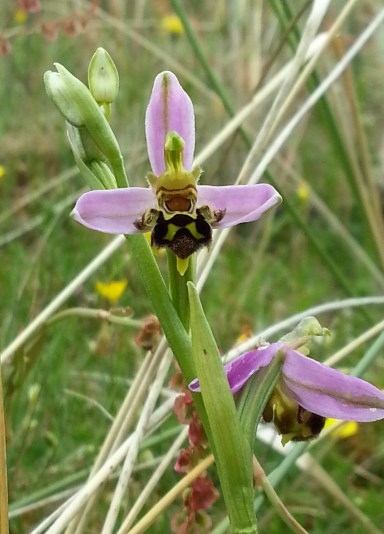
Bee Orchid (Ophrys apifera) flowering in Donegal coastal grasslands (photo: J. Stout 2014)
The unusual looking flower that gives this plant its name (Ophrys apparently comes from the Greek for “eyebrow” and apifera from the Latin meaning “bee-bearing” or “bee-bringing”) has evolved as as a result of its pollination system, which relies on sexual deception. The flower looks, feels and smells like a female bee (to a male bee) who is attracted, and attempts to copulate with the flower. In doing so, he unwittingly picks up a packet of pollen (orchid pollen is packaged into pollinia), and when he gives up on the current flower, and moves on to be deceived by another, he transfers it. Hence the plant disperses its pollen to other bee orchids. This pollination mechanism is known as “pseudocopulation”.
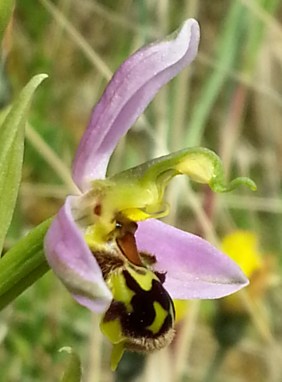
Although the Ophrys apifera flowers doesn’t look, feel and smell like bee to us, it does give enough “female bee” signals to fool the males – the “furry” texture of the rounded lower petal that looks and feels like a bee’s abdomen whilst she forages from the pink bloom, and the iridescent patterns that catch the light in a similar way to the folded wings of a foraging bee. Each of these signals on their own may not fool a male bee, but the flowers also emit a scent that mimics the female pheromones (see the wonderfully titled paper by Florian Schiestl “Orchid pollination by sexual swindle“). And this is what seals the deal. In fact, research has shown that the scents emitted by a closely related species (Ophrys exaltata) are not a perfect mimic of the female bee pheromones, but are actually moreattractive to the male bees than female bees themselves!
The flower that pretends to be a bee (photo: J. Stout 2014)
The genus Orphys contains a broad range of species across Europe, north Africa and western Asia, each of which has evolved specific signals to attract particular species of insect pollinator. The only other species from this genus present in Ireland is the Fly Orchid Orphys insectifera, which is found in a limited number of calcareous wetland sites (fens, peaty depressions in limestone pavements, and turloughs) in the midlands and west of Ireland (in England it’s found more often in woodlands and scrub) and, despite the name, attracts digger wasps to its flowers.
The Bee Orchid Ophrys apifera is widespread in central and southern Europe, but at their northern limits in Ireland and Britain. And here in Ireland, where flowers appear in June and July, we don’t have the bees that these orchids have evolved to fool (solitary long-horn bees, Eucera longicornis). So instead, this species has evolved the ability to self-pollinate in areas where the pollinators are not present. This occurs as the pollinia (the yellow blobs hanging from the top of the flower entrance) swing freely and either contract or bend as they age, or a gust of wind can blow them onto the stigmatic surface (as in the picture above).
Bee Orchids long been know from botanical hotspots like the Burren in Co. Clare and Bull Island in Dublin, and this perennial species tends to be found in open, semi-dry grasslands on limestone, and calcareous dunes. It’s a protected species in Northern Ireland, but not on the Floral Protection Order in RoI. Bee Orchids colonise sites disturbed by human activity, like roadside verges, old quarries, gravel pits and in urban settings. They prefers open habitats, and are out-competed by shrubs and trees if a site becomes overgrown. Thus to maintain populations of Bee Orchids, mowing or grazing needs to occur at the end of the season, and the cuttings removed.
Like many orchids, Bee Orchids form symbiotic relationships with mycorrhizal fungi, which extract nutrients from the soil and transfer them to the plant via its roots. The use of fungicides could reduce the prevalence of these mutualists, which may limit where the bee orchids can grow. Other pressures on Bee Orchid populations include ploughing of grasslands, and if mowing occurs during flowering or before the tiny, wind-dispersed seeds have formed and been released, populations can decline.
Despite their remarkable flowers, the plants can be easily overlooked unless you are looking for them. But because the flowers are so bizarre, and can’t be confused with anything else, Bee Orchids can excite even the least botanically minded people.
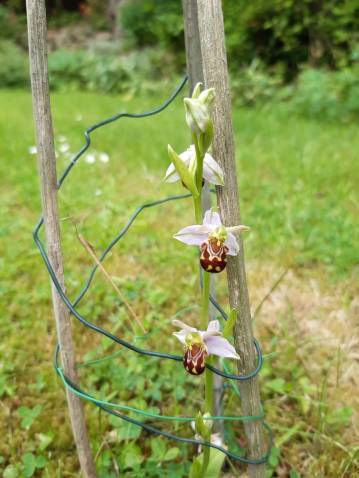
Bee orchids growing (and protected ) in my mum’s lawn! (photo: V. Stout 2020)
Last year, we started a biodiversity audit at Áras an Uachtaráin, the iconic home of Ireland’s President Michael D. Higgins. This was at the request of the President himself, commissioned by the Office of Public Works, who manage the site.
President Higgins was at the Rio Earth SummitRio Earth Summit in 1992, and has been an advocate for biodiversity protection for a long time. He gave an impassioned speech at the National Biodiversity Conference last year, highlighting that we face “profound challenges” and that we all need to be leaders within our own spheres of influence (see my previous blog post here for a summary of the conference).
So, starting late summer 2019, we began a process of documenting the biodiversity of the 130 acre site in the Phoenix Park in Dublin. The first task was to appoint a project manager, and I was very lucky that Dr Aoibheann Gaughran was both available and interested in the position. The first task for Aoibheann was to create a GIS-based habitat map of the site, and identify all the different the habitats types present (grassland, woodland, parkland, wetland etc.).
The next step was to document all the different species. No-one is an expert in every taxonomic group, and one of the delights of this project has been bringing together a team of specialists to survey the plants, animals and fungi (see below).
Our surveys were interrupted by the COVID 19 pandemic and closures, but we are now back at it and enjoying the privilege of working in the Áras grounds.
Aoibheann doing plant quadrats
Jane checking the pan traps
Blue tailed damselfly
the pond
Simon in the woods
common blue butterfly
Naturally, there has been a lot of interest in the project, with the President’s team keeping an eye on us, as well as the media (see links from the President’s website: News release and pictures, RTE news, and the Irish Times.
The “Mooney Goes Wild” show on RTE radio has featured the project several times:
Introduction to the project: Margaret Gormley (broadcast 20 January)
Mushrooms: Prof. Paul Dowding (broadcast 27 January)
Bird life: Prof. Nicola Marple (broadcast 30 March)
Spiders and Badgers: Dr. Aoibheann Gaughran and Collie Ennis (broadcast 20 April)
The project is due to be completed in September 2020 – keep an eye out for our results!
INCASE (Irish Natural Capital Accounting for Sustainable Environments) project ecologist DR CATHERINE FARRELL reports on the work done so far in taking the basic information sets available for the different natural systems in Ireland and building the picture around their extent and conditions. The next steps for INCASE are set out here…
The Irish landscape: a mosaic of natural, semi-natural and built habitats – mapping these fragments (extent and condition) is a fundamental element of natural capital accounting
It’s been a busy year. Last June – fresh as a newly sprung daisy – I sauntered through the front gates of Trinity College Dublin, ready to take on the brave new world of natural capital accounting as part of the INCASE project team. Flash forward almost 12 months and those revered Trinity gates are closed as the global human community finds itself immersed in a pandemic.
Life goes on though and thankfully we have been working away on the INCASE project to bring forth a first draft (otherwise known as an organised mess) of our extent and condition accounts in time and on track for the autumn of 2020.
Once the lockdown began in March, what was one to do but take advantage of a diary emptied of meetings and conferences and set about building the basic blocks for our accounts?
First step – review what’s out there that we can use. Luckily for us, there has been an extensive amount of groundwork done across Europe under the EU Mapping and Assessment of Ecosystem Services projects (EU MAES). The MAES team has done the heavy lifting around what is available at the EU level to establish extent and condition accounts. But what is available at EU level isn’t sufficient for what we need at the local Irish level, and the typology used is different to what we use here. The EU MAES project developed a high-level map of ecosystem types and extent of those types. The types follow the Corine Land Cover mapping classes – which is fine if you live in space and you just want to know where solid ground is so you can land your spaceship (avoid the bogs!). But if you are on the ground in Ireland, you need to get into the finer detail of what makes up the terrestrial systems of grassland, croplands, forests and woodlands and built / urban, as well as the freshwater (wetlands, peatlands, rivers and lakes), and marine systems; and then what lies beneath (geosystem) and above (atmospheric systems). That’s a lot of systems and a lot of detail.
So, we have been building the basic information sets around what is available for the different natural systems in Ireland. With the help of our friends and colleagues in the NPWS, DAFM (Forest Service), Government Departments, Research Institutes, BIM and Geological Survey Ireland, we have a clearer picture of how we can map different units as well as the main drivers (policy instruments such as agricultural and forestry targets), pressures (think population growth, land conversion, climate change) and their resulting condition (state – think polluted water course versus crystal clear stream) .
Let’s focus on Freshwater ecosystems for a moment – this ecosystem type includes rivers, lakes, swamp, peatlands, wet heathlands, turloughs and a few other bits. Each of these unique natural systems has evolved and developed in the context of the time, landscape, geology, hydrology and climate. Each has specific characteristics, and each has been ‘used’ or ‘modified’ by humans for a specific purpose, and therefore affected in a myriad of different ways. The drivers of change, the resultant pressures, and how those pressures manifest the impacts and resultant present-day state (condition) are complex stories to say the least.
So where are we at? With the help of our new GIS analyst and data manager, Lisa Coleman, we are gathering and building the stories for extent and condition. Of course, while developing extent and condition, we will continue to work on the services in the background but it’s important to get the foundations right!
Here’s what we will (hope to) do over the next few months (pandemic permitting!):
For the extent accounts:
Starting with the sub-basins of the Dargle catchment in County Wicklow, INCASE will test the EnSym model using the available datasets to establish extent (cover) of grassland, cropland, peatland, heathland, woodland, forest, built and freshwater habitats, as well as coastal and marine (where feasible) habitats; and geological assets.
INCASE will use nationally available datasets (including the new OSI/EPA Landcover which is due for completion any day now!) to establish this ‘first cut’ of the extent maps.
INCASE will use the NPWS MAES HAR 2016 as a reference / baseline as well as accessing those datasets already processed in 2016 for ease of use by INCASE.
The final topology for the different natural systems will be developed over the course of the extent mapping. Note: Fossitt 2000 is widely used in Ireland but is being gradually superseded by the newly developed IVC classification. It is unlikely INCASE will be able to map to Fossitt Level 3 or the IVC comparable levels of detail and some ground-truthing will be required.
Condition indicators will be selected from existing data sources that reflect the ‘functional’ aspects of each natural system.
Diversity is obviously a key indicator of resilience; INCASE will use NPWS habitat and species extent data where available, as well as condition (Article 17 reporting) and National Biodiversity Data Centre data.
The SEEA-EEA recommends the use of 6-10 condition indicators, however we will begin with what is available and reliable during the course of the project.
Examples of condition indicators will include drainage (peatland), vegetation cover and/or erosion (peatland and heathland), canopy cover and species composition (woodland and forest), management (grassland and cropland), water quality (freshwater) and green and blue infrastructure (built systems). Proxies for condition will also be used and these will include pressure, land use and management.
These condition indicators will be used as baseline to establish the condition of the different natural systems (good or bad – Note: this is INCASE working terminology!) as well as data gaps and needs for further reporting.
Highly managed systems (referred to as Intensive Land-Use systems / Artificial systems) in IUCN GET) such as cropland, forest, intensive grassland and built systems will be treated in a different way as these are artificially modified to deliver food, fibre, timber, fodder, fish, living space etc. For these ‘less natural’ systems, which are managed for their capacity to deliver commercially valuable goods and services, condition indicators will be explored to reflect whether these services are delivered in a sustainable way; that is without damaging other natural systems and their functional characteristics and /or their capacity to deliver ecosystem services.
Sign up for our newsletter to keep up to date with our applied Natural Capital project.
Creating evidence base for protecting bees and other pollinators on farmland
Post-docs Stephanie Maher and Simon Hodge are working on the Farm-Ecos project assessing semi-natural habitats, such as hedgerows, on farms with different production intensities in Wexford and Sligo. The next step in the project is to evaluate the quality of these habitats in terms of the abundance and diversity of the pollinating insects, such as wild bees and hoverflies, they support throughout the year.
Steph and Simon are also working on projects examining the ecology of solitary bees on Irish farms.
Steph is working on ground-nesting bees and aiming to better understand the soil conditions and types of substrates these bees prefer, and how well these habitats are provided for in environmental policy. Simon is investigating how stem nesting bees utilize artificial nests and how the success of these nests is affected by factors such as the diameter of the nesting tubes and their height above the ground.
New PhD student Ceri Green is researching pollinators on beef-farmland in Ireland, and how the implementation of biodiversity-friendly management actions can enhance pollinators. This project is co-funded by the IRC and Kepak as an Enterprise Partnership.
Bee Health
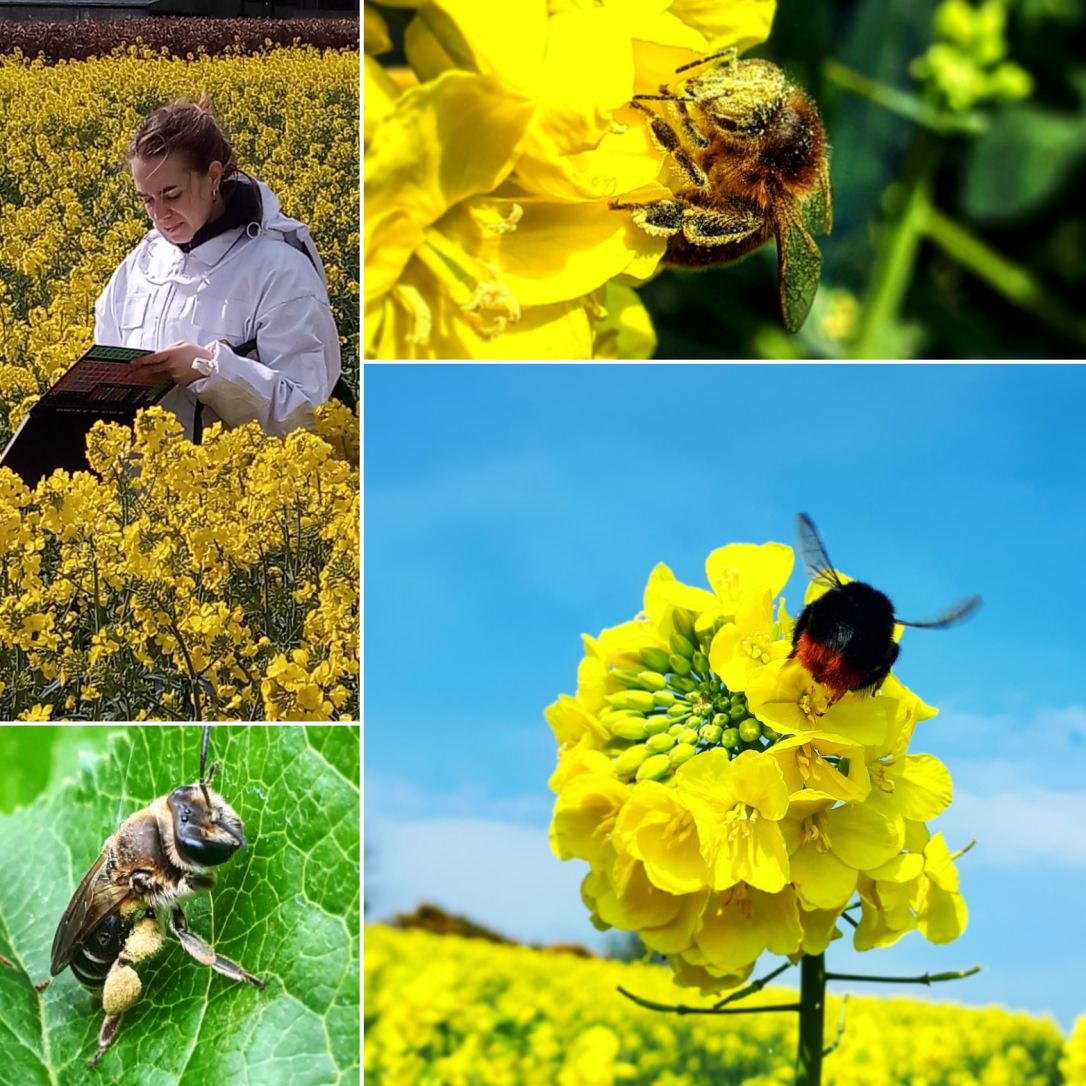
The PoshBee project is collecting data on the threats affecting bee health across Europe. Samples of honey bees, bumble bees, other pollinators and floral resources have been collected from oilseed rape and apples orchards, and will be assessed for contamination by pesticides and heavy metals, and the presence of diseases. PhD student Irene Bottero is investigating how different habitats and floral resources available in field boundaries affect the pollinator communities in Irish mass-flowering crops.
Irene in the field surveying flower visitors to Oilseed rape
Also as part of the PoshBee project, Jordan Chetcuti is working on creating a framework for Bombus sp. modeling within the ALMaSS framework (Animal Landscape and Man Simulation System). He will then parameterise the first ALMaSS Bombus sp. individual-based model for Bombus terrestris which will be used to assess the risks associated with different farming practices, as well as gaining insights into bumblebee ecology.
The PROTECTS project is investigating pesticide usage in Ireland and implications for bee health. The role of PhD student Elena Zioga is to detect and quantify the pesticide residues found in pollen and nectar of crops and wild plants.
Elena in the field collecting flowers from Oilseed rape and Bramble to extract nectar and pollen
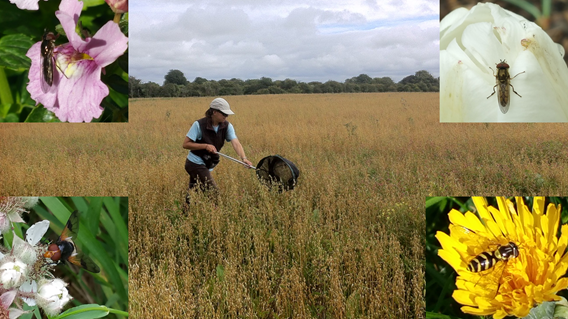
PhD student Sarah Gabel is researching agricultural impacts on the health of hoverfly pollinators, also called flower flies. She is looking at how hedges relate to hoverfly diversity, and how pesticides affect behaviour. #LoveIrishResearch
Sarah sampling hoverflies in oat fields
Urban bees
The Connecting Nature project aims to create Nature-based Solutions to many contemporary problems, from climate change and rising sea levels to social cohesion and health. PhD student Cian White has conducted research on urban wildflower meadows, looking at the multiple benefits they provide, both aesthetically and from a conservation of biodiversity point of view. Cian is also looking at how urban and agricultural landscapes impact plant and pollinator communities and the interaction networks they form.
Cian sampling plants and pollinators at Castletown
Urban wildflower meadow
Post-doc Aoibheann Gaughranis managing the team of Trinity ecologists completing a year-long biodiversity audit of Áras an Uachtaráin at the request of President Michael D Higgins and the Office of Public Works. The team will make recommendations on positive measures for biodiversity in the future management of the house and grounds. Habitats on-site include meadows, parkland, formal gardens and an organic vegetable garden and orchard, and surveys have already revealed a host of solitary and bumble bees including Andrena lapponica and Bombus pascuorum foraging on both wildflowers and planted cultivars.
Jane checking the pan traps
Aoibheann doing plant quadrats
Bombus pascuorum
Andrena lapponica
All of this research helps to provide the evidence base for practical conservation of bees and other pollinators across farmland, (semi) natural and urban habitats, providing advice to stakeholders, and for developing policy. As Phase 1 of the All-Ireland Pollinator Plan (AIPP) draws to an end, Jane Stout is working with Úna FitzPatrick at the National Biodiversity Data Centre, and the AIPP Steering Group to develop AIPP II 2021-2025. Our efforts in Ireland feed into the EU Pollinators Initiative as well as global efforts via Promote Pollinators and the International Pollinator Initiative. Together we can make a difference!
There are >20,000 different species of bee worldwide. They are a diverse group, encompassing the tiny 2mm long Perdita minimaand the massive 38mm long Megachile pluto. They all* have one thing in common: their larvae feed on pollen from flowers. The protein in the pollen is necessary for larval growth and development, and thus for producing healthy adult bees. When visiting flowers to collect pollen and nectar to fuel flight, adult bees transfer that pollen from flower to flower, thus making them brilliant pollinators.
And bees are ever-increasing in popularity across many sectors including conservation, gardening, fashion, marketing, and public/corporate strategies. Their popularity means that there has been an increase into bee research, and lots of excellent conservation strategies (including our own All-Ireland Pollinator Plan), but it also means there has been a lot of mis-use of bees in corporate and even well-meaning conservation strategies (see Charlotte de Keyzer’s excellent “bee-washing” website). And as their popularity spreads, so does the amount of incorrect information about them, which makes an Melittologist (someone who studies bees), buzz with frustration…
So here’s a blog I’ve been meaning to write for some time** – six statements about bees that are often used, but aren’t true…
1. One in three bites of food (or one third of food) depends on bee pollination: this one pops up on my twitter feed, in articles, talks, publications all the time…
The source of this “one in three” or “one third” quote is thought to be a 1976 Pollination Handbook, which says “it appears that perhaps one-third of our total diet is dependent, directly or indirectly, upon insect-pollinated plants.”
In 2007, an excellent paper by Alex Klein and co-authors was published, which states in its abstract “60% of global production comes from crops that do not depend on animal pollination, 35% from crops that depend on pollinators, and 5% are unevaluated”. But if you read the paper properly, you will see “Production of 39 of the leading 57 single crops increases with pollinating animals… account[ing] for 35% (23×108 Mt) of global food production”. But the authors acknowledge that not all crops are entirely dependent on animal pollination, i.e. animal pollination can increase fruit or seed production, but exclusion of animal pollinators does not inhibit it entirely for all crops. Thus the amount of production directly attributable to animals is probably lower. And the data were only taken from crops that produce fruits or seeds for direct human use as food.
So the “one-third/one-in-three bites depending on bees” is wrong for several reasons:
i) it’s not just bees that pollinate food crops, and certainly not just honey bees – wild and unmanaged pollinators, including insects that aren’t bees, are important for crop production.
ii) these crops aren’t 100% dependent on animal pollination – the level of dependency varies among crop types and even varieties within crops and across with geographic context, and so the plants aren’t “dependent” on animal pollination, but benefit from it in terms of increased quantity and/or quality of yields
iii) we get food from sources other than directly from crops – this study only included crops that are used directly as human food – it does not include fodder crops for animals (which are then consumed by humans), it does not include processed foods.
The other thing to remember is that bees and other flower-visiting animals are responsible for pollinating the vast majority of all flowering plant species on earth – they aren’t just important because they contribute to the human food system. They have many other values to us, and are an intrinsic part of functioning ecosystems.
2. Einstein quote: “If the bee disappeared off the face of the earth, man would only have four years left to live”. There is no evidence that Einstein ever said this – according to Quote investigator, he was linked with bees in the Canadian Bee Journal in 1941, and the 4-year deadline was attributed to him by a French publication ten years after this death. But there is no evidence Einstein ever calculated the fate of humanity in the absence of bees. Jeff Ollerton has a nice blog on this topic here and I don’t need to repeat.
3. The bee is in decline and needs our help: which bee are we talking about here? This is a massive over-generalisation of a group which comprises >20,000 different species worldwide (see excellent blog by Manu Saunders), and the point is that not all of them are in decline. In fact, some are doing very well, thank you very much, particularly the ones that can thrive in human-modified landscapes (whether urban or agricultural). One species that has been spreading its distribution westwards over the past two decades is Bombus hypnorum, the tree bumblebee (see pages 70-71 of Rasmont et al. 2015) – I first saw one individual of this species in southern England in 2000 (I wasn’t quick enough to catch it!), so it was first officially recorded in 2001, and spread rapidly northwards after that. In 2017, it turned up in Dublin.
On the other hand, there are some species that have rapidly declined: 30% of Irish species are threatened, and a whopping 77 species of bee face extinction across Europe, including 22 species that don’t occur anywhere else in the world. Some are threatened by climate change: for example, Bombus polaris, which is restricted to the mountains of Scandinavia and tundra of the Arctic, is likely to lose suitable habitat and to be extinct by 2050 (see pages 102-103 of Rasmont et al. 2015). But others are threatened by the familiar drivers of biodiversity decline: habitat loss, destruction, degradation and fragmentation, agrochemicals, parasites and diseases and other invasive species, and the combination of these stressors.
In fact, we don’t know nearly enough about most bee species to know whether they are in decline or not. Of the 1,942 species in Europe, more than half (1,101) were deemed “Data Deficient” during the Red-Listing process of 2015. That means that for more than half our bees, their extinction risk is officially unknown. However, studies from Europe and North America have shown declines in species richness and distributions of bees (Biesmeijer et al. 2006, Kosior et al. 2007), shifts in community compositions (Bommarco et al. 2011, Dupont et al. 2011), and declines in abundance (Cameron et al. 2011). A shocking report published recently (Zattara and Aizen 2019), using GBIF data, showed steep downward trends in bee species globally since 1990s. The body of evidence thus suggests that bee decline is a widespread phenomenon in many species, even if we don’t yet have all the data.
4. Honey bees are most threatened and in need our help: Honey bees (and one species in particular, the “Western” or “European” honey bee, Apis mellifera) are managed by beekeepers worldwide, having been introduced by European colonists. And the number of beehives worldwide is not in decline, with numbers increasing steadily across the world, and in the EU (see graph below).
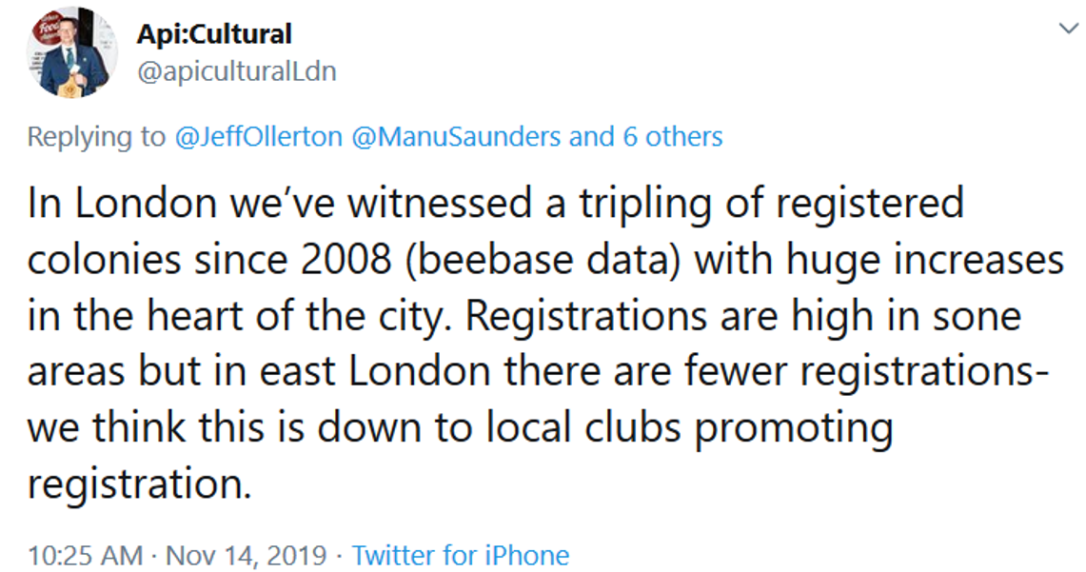
Honey bees are the most widely used managed bees for crop-pollination, despite not always being the best pollinators. With the increasingly popularity of bees as a flagship for conservation, and well-intentioned increases in urban beekeeping, numbers will probably continue to rise.
Beekeeping is of course not a solution to decline in wild bee species, and can sometimes actually exacerbate problems for wild bees (I’m not going to go into this now, but for example see Hannah Hamilton’s Irish Times article, and articles in Science and The Conversation).
Whether wild populations of Apis mellifera are in decline is less well known: Apis mellifera was deemed “Data Deficient” in the European Red List process (see Page 17 of the report), and wild, feral colonies, formed by bees escaping from managed colonies, are often not self-sustaining. Because Apis mellifera has been managed by beekeepers for hundreds of years, and selected for honey production and docility rather than resilience to environmental pressures, they may be less able to cope with environmental change (climate, parasites, disease etc.). And some authors are arguing that, in their native range, honey bees do need conserving (see Requier et al. 2019)
5. Bees die when they sting: only honey bees die when they sting – most other bees can happily sting and fly away unharmed. The reason that honey bees die when they sting, is because their sting is barbed, meaning it gets lodged in the flesh of the creature it stings, and when it attempts to fly away, its stinger and parts of its digestive tract, muscles and nerves get left behind. Unfortunately, the honey bee does not survive this damage to its abdomen.
The bees’ stinger is actually more like a hollow needle, but attached to the sting is a venom sack – it is this venom that causes the reaction when it enters your body. The venom contains a cocktail of chemicals that cause pain, stop blood flow, histamines that give an allergic reaction and also pheromones, which stimulates a defence response to nestmates, who may also sting.
And why on earth have honey bees evolved to die when they sting you? Well, one reason is that there are no selection pressures to stop them from dying, as worker honey bees do not reproduce anyway – for more detail see here.
Did you know that it’s only female bees, ants and wasps that can sting? That’s because the sting has evolved from a modified ovipositor – the egg-lying tool of insects – and males don’t lay eggs.
6. Bees live in colonies in hives: Only approximately 10% of the world’s bee species are social and live in colonies. The vast majority of bee species are solitary, which means that a single female constructs her own nest, defends it from predators, lays eggs, and collects all the food for her offspring. Although many females can nest in aggregations, each has her own nest. These nests can be constructed in a wide variety of places, many of them in the ground, but others create or use cavities in wood, sandstone, snail shells or even within the nests of other social insects. The brood cells in these nests can be incredible feats of engineering, using mud, resin, leaves flower petals, plant fibers and even, in some urban environments, rubbish, like old plastic bags.
There is much less known about solitary bees, compared with their social cousins, but a wonderful book has just been published, which I thoroughly recommend if you are interested in getting to know more about solitary bees.
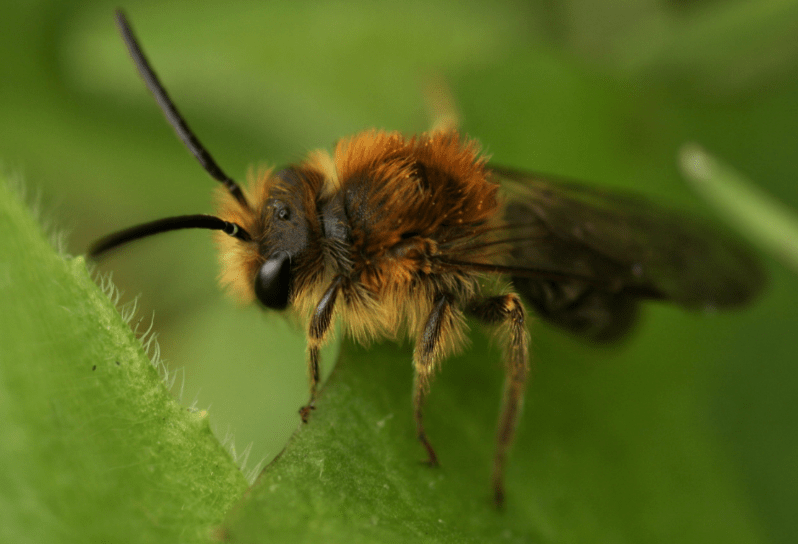
Solitary mining bee (photo by Laura Russo)
So, there you go, six things that have been bugging me and I felt the need to share! I am sure there are many others out there, so feel free to comment!
*Except Vulture bees, which are a small group of three closely related North American stingless bee species in the genus Trigona that feed on rotting meat. They substitute meat for pollen, but still make honey from nectar. This unusual behavior was only discovered in 1982, nearly two centuries after the bees were first classified.
**It took me so long to finish this, that Úna FitzPatrick, leader of the All-Ireland Pollinator Plan, beat me to it and published this excellent blog, with lots of myth busting and good advice about how to conserve bees.