Blog

Ecological adventures in Kenya

Trinity College Dublin runs an annual tropical ecology and conservation field course to Kenya for students in the School of Natural Sciences. This year, I had the privilege of being the botanist on the trip, which gave me the opportunity to teach an excellent group of students, learn from expert instructors, and see a great deal of Kenya.  I felt pretty special because the other instructors on the course were amazing, from the incredible birders John Rochford and Nicola Marples to the amazing physiological ecologist Colleen Farmer all led by the ecological prowess of Ian Donohue. Of course, Collie Ennis, the amazing herpetologist, was also there (he was on the Late Late Show, you know).

Laura Kenya 9
Figure 1 Lunch at Lake Baringo.

The trip is nine days and it is a fast paced trip around four main sites in Kenya: Lake Nakuru National Park, Lake Baringo National Park, Lake Naivasha, and the Maasai Mara. The trip involves several game drives, where the students have a chance to see the famous African “big five”: lion, leopard, elephant, buffalo, and rhinoceros. It provided incredible opportunities to watch ecological processes in action, including five cheetahs devouring a wildebeest.
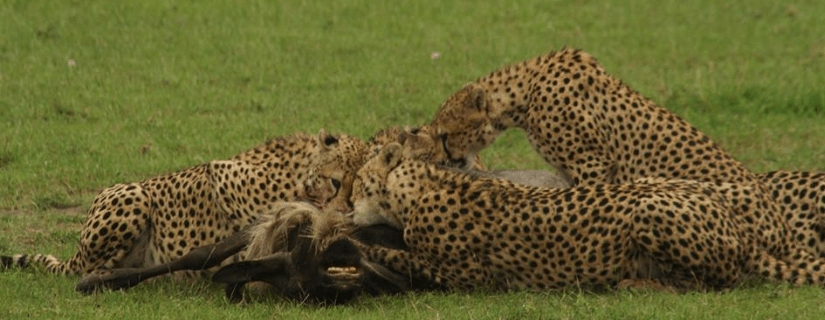
Laura Kenya 1
Cheetah having Wildebeest for lunch

But there’s so much more than that… this trip gives the students the opportunity to observe the challenges facing conservation in Kenya: small reserves where the population density of herbivores gets so high that buffaloes sometimes kill lions and where, as a result, the lions have learned to sleep in the trees, invasive plant species filling in where overgrazing leaves open spaces, pollution clogging streams, flooding at all of the Rift Valley Lakes, aridification of agricultural regions, and human-wildlife conflicts.
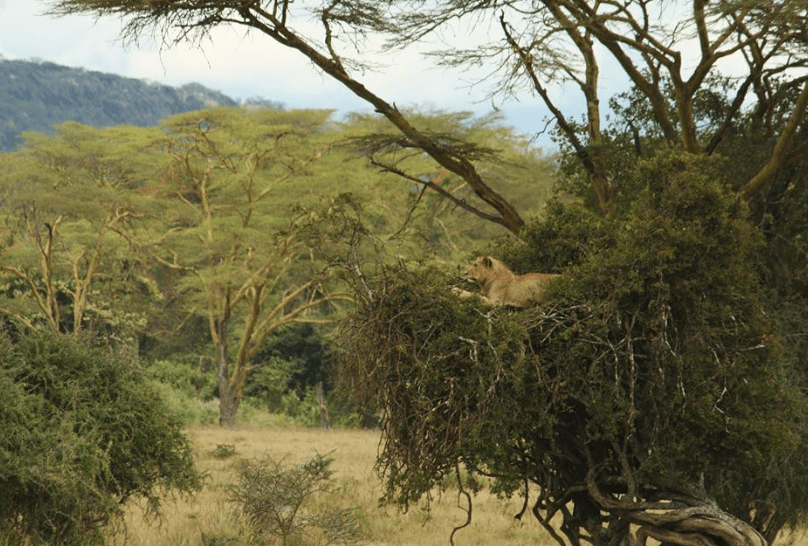
Laura Kenya 2
Figure 2 Lion sleeping in a tree in Lake Nakuru National Park.

I’m personally fascinated by the reptiles, amphibians, mammals, and birds of Kenya, but as the official botanist on the trip it was my job to try and draw the students’ attention to the less mobile (but no less charismatic!!) flora of Kenya. The flora exhibited incredible variation from site to site, but at each site, invasive species (like Prosopis julifera and Opuntia) were in full force.

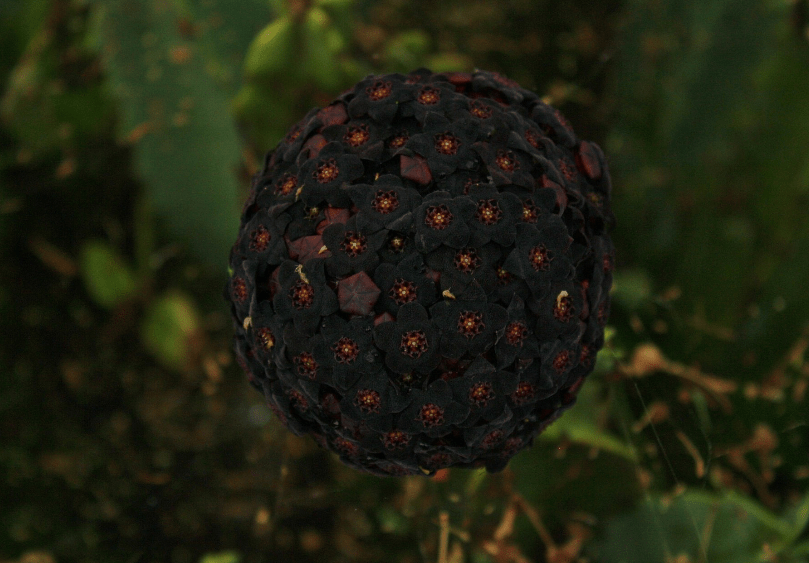
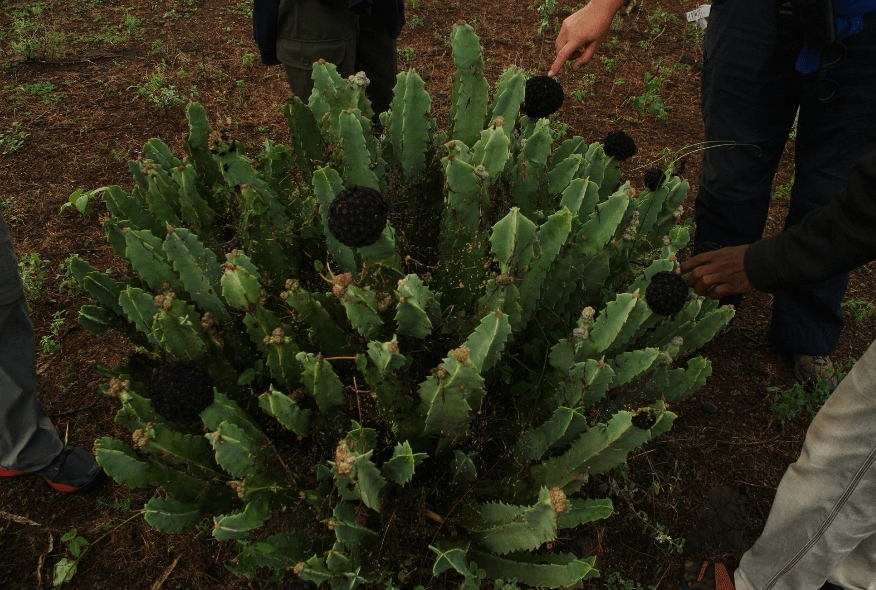
I was more interested in the native Kenyan flora. I wanted to find a weird Apocynaceae genus Ceropegia (I did not, alas), but I did find Caralluma acutangula in the same family. This plant is so cool because it is a cactus-like succulent in the milkweed family: a perfect example of convergent evolution.
Laura Kenya 3

Laura Kenya 4
Caralluma acutangula

In the Old World, the Euphorbiaceae fill the niche that the Cactacecae fill in the New World. They are incredibly diverse and successful, but probably the most striking of the Euphorbia (to me) is Euphorbia candelabrum. It reminds me of the giant Saguaro cacti iconic of the desert southwest in North America.

Figure 3 Euphorbia candelabrum in Kenya (left) and Saguaro cactus in Arizona, US (right) (human for scale).

Of course, in Kenya you really can’t ignore the Acacia (now Vachellia). I mean you really can’t ignore them, since they are covered in painful thorns. One species in particular, the catclaw acacia or “wait a bit” (Vachellia mellifera), uses backward facing thorns to give you time to pause and think about the plant. Note that similarly thorny plants, with similar nicknames, are found around the world, including Australia’s wait-a-while (aka “lawyer cane”, Calamus australis) and the New World’s “wait-a-bit” (Senegalia greggii). Another case of convergent evolution, as both wait-a-bits are Fabaceae but the Australian “wait-a-while” is in the palm family Arecaceae.

Laura Kenya 7
Figure 4 Bat hanging out on a very spiny Vachellia.

It’s hard to be too angry at Vachellia mellifera, since the honeybees make such a delicious honey out of it! Many of us on the course brought home a few bottles of Kenyan acacia honey made from the nectar of the very tree plucking at our clothing and knocking off our hats.

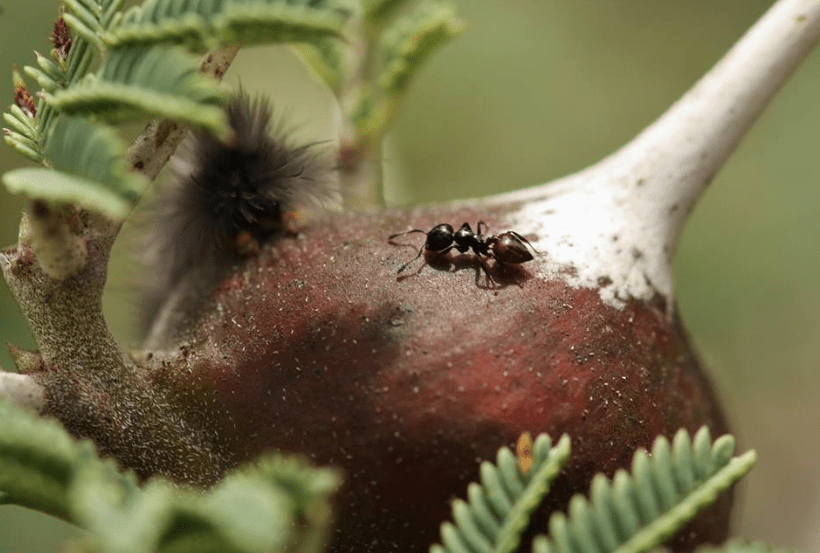
Because I am fascinated by mutualisms, I was most excited to see the famous whistling thorn acacia (Vachellia drepanolobium) being actively defended by one of its mutualistic ant occupants.
Laura Kenya 8
Figure 5 Mutualistic ant defending its plant host from an herbivore.

The plants of Kenya have many mysteries to explore and fascinate the botanical mind. There are well over 10,000 species of flowering plants in Kenya, though a lack of sufficient research means the real number is unknown. I can’t wait to go back and learn more and if you’re interested in this field course (or really any tropical field course), don’t forget to keep an eye on the plants!

Dr Laura Russo is a post-doctoral Research Fellow in School of Natural Sciences, Trinity College Dublin. The fieldcourse is part of the final year programme for Zoology, Botany/Plant Sciences and Environmental Sciences students on the TR060 Biological and Biomedical Sciences degree programme.

Starting with soil…

Dr Laura Russo, post-doctoral Marie Skłodowska-Curie Research Fellow, working on how agrochemicals affect plant-pollinator interactions, describes her first foray into soil analysis…

After discussing my experimental design with collaborators at Teagasc, I realized it was essential to establish the background composition of the soil, to determine whether a) my treatment had an effect on the soil composition over time and/or b) whether the background soil composition at my different sites influenced the health of the plants and their response to my experimental treatments.

For this reason, I took soil samples from each plot at each site in the spring before treatments were applied and then resampled all of the plots at the end of the season after the last treatments of the year were applied.

Thus armed with many kilos of soil samples, I waddled into the soil lab at TCD. I put on a lab coat, latex gloves, and safety glasses, then, under the expert tutelage of Mark Kavanagh (Botany Technical Officer), I conducted some basic analyses on these soil samples:

  • pH
  • Total organic matter in the soil
  • C and N content of the soil
  • P and K content in the soil

The first step to any soil analysis is to air dry the soil samples and sieve them through 2 mm sieves. This removes any large rocks and helps to break up chunks of soil. Don’t underestimate how long this step will take (if you’re doing it by hand)! To process my 32 samples, I spent a few hours a day for about 5 days sieving soil samples.

The next step is to get the soil really dry using a drying oven set to 100C for 24 hours. It’s important to measure how much water (through weight) is lost during this drying step, as you may need that to back calculate future analyses on air dried soil samples, which still have some moisture in them due to humidity in the air.

After those preparatory steps, I took the pH of the sieved and air dried samples. To do this, I measured 1 part soil to 5 parts distilled water and put them on a shake table for 60 minutes. After letting them rest for 10 minutes, I took the pH of each of these samples using a calibrated pH probe.

An important thing to note here is that it’s a good idea to subsample your soil samples to see how much variation there is within a given analysis. Obviously, if there’s more variation between subsamples within a sample than between different samples, that analysis is not revealing any meaningful variation between sites or treatments.

I used the oven-dried samples to then measure the total organic matter in the soil, keeping them in a desiccator while weighing them out to ensure that they didn’t absorb any moisture from the air (which would artificially inflate the organic content by making them heavier). Once the samples are weighed into crucibles, they can be placed in a furnace at 500C for 3 hours.

Laura Soil 1
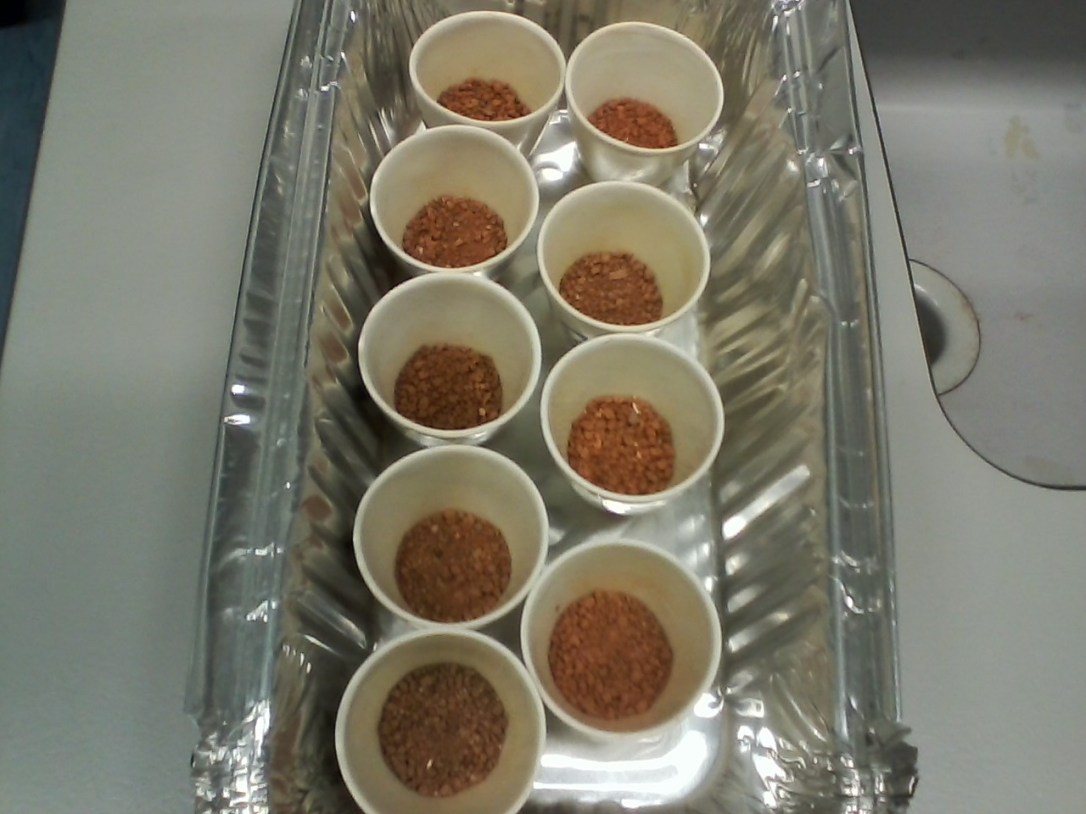
Figure 1 Soil samples before being dried in a 500C oven.

The most interesting thing about this step was that before the samples went into the furnace, they varied in colour and texture (Figure 1), suggesting there was a variety of soil compositions. However, after they were cooked in the furnace, burning off all organic matter…

Laura Soil 2
Figure 2 Soil samples after being dried in a 500C oven.

They all changed to the same colour! This visible change was really striking to me, not only because they looked so different before and after, but because after the furnace all the variation between samples disappeared. That suggests to me that the colour variation was all due to organic matter, which is just cool.

The next analysis I did was on the total carbon and nitrogen content of the soil. To do this, I had to mill all my samples to a fine dust. To do this, I measured out a known weight of air-dried soil into bowls with zirconium oxide balls, and then put them in a ball mill. The mill spins the samples around at 650 rotations per minute for two minutes…in other words, really fast! The bowls have to be very securely fastened in the mill or they can explode out of it. Fortunately, that did not happen with my samples. They were all well-secured and milled into a very fine powder.

This fine powder was then measured into tiny tin cups, which was dropped into a vario TOC cube, which measures nitrogen and carbon content by means of high temperature digestion.

Finally, I measured the amount of P and K in the soil by doing a nitric acid digestion of the oven-dried soil samples. For the nitric acid digestion, I weighed a known volume of dried soil into glass tubes and then added 10mL 69% nitric acid. These tubes were left to cold digest for 24 hours, then they were boiled at 120C for 2hr and 140C for 1hr.

After all the samples cooled, the compounds of interest were in the supernatant, so I filtered the soil out and diluted the samples to 100mL with distilled water. This step was really interesting because of the beautiful colours that appeared.

Laura Soil 3
Figure 3 Beautiful colours of filtered soil samples in nitric acid.

Not only were these colours aesthetically appealing, they also correlated strongly with site. Two of the sites were orange, one was pale yellow, and one was bright red! These colours are likely related to metals in the soil (for example, iron shows up as red).

Laura Soil 4
Figure 4 More pretty sample colours.

Stay posted if you want to hear more about the results of my analyses!


Buzz from the hive…

By Marcus Phelan

The Winter frost has arrived and the hives on the Trinity roof are now lulled and still. Just as the College community welcomes the lighting of the Christmas tree with mince pies and hot drinks so too must the honeybee colonies protect themselves from the perishing cold. In her last post Susie described the expansion of the apiary over Summer. I am happy to report that the colony led by one of Queen Medb’s own progeny and the nuc kindly donated by Kilternan beekeepers are heading into Winter in good shape; as well as Medb herself, of course.

Stores of honey (with a little helping of fondant) will provide sustenance until the abundance of Spring returns. The fondant or ‘bee Christmas cake’ is suffused with pollen, as the carbohydrates of the sugar must be supplemented with protein-rich pollen to provide a balanced diet. This helps to strengthen the colony in the absence of naturally occurring pollen. Ivy and other late Autumn pollen producers have dwindled by now. So the larder is well stocked with provisions for the long cold months ahead.

But what do bees do to protect against the cold? The answer lies in an amazing adaptation that allows the honeybee to maintain the temperature of the ‘cluster’ in an overwintering hive. Bees have the ability to decouple their wings from their muscles thus isolating wing movement. By then activating the wing muscles they can produce heat rather than movement, generating warmth within the hive. The interior temperature can be maintained at 20-30 degrees Celsius despite outside temperatures dipping below zero.

As the bees wait out the colder part of the year us beekeepers must prepare for the year ahead, hopeful of a successful emergence in Spring. Plans are already afoot in the apiary to assist in further research programmes and the Trinity bees are certainly earning their keep, as well as enriching the College environment.

Nollaig Shona Daoibh from the Trinity Beekeepers!


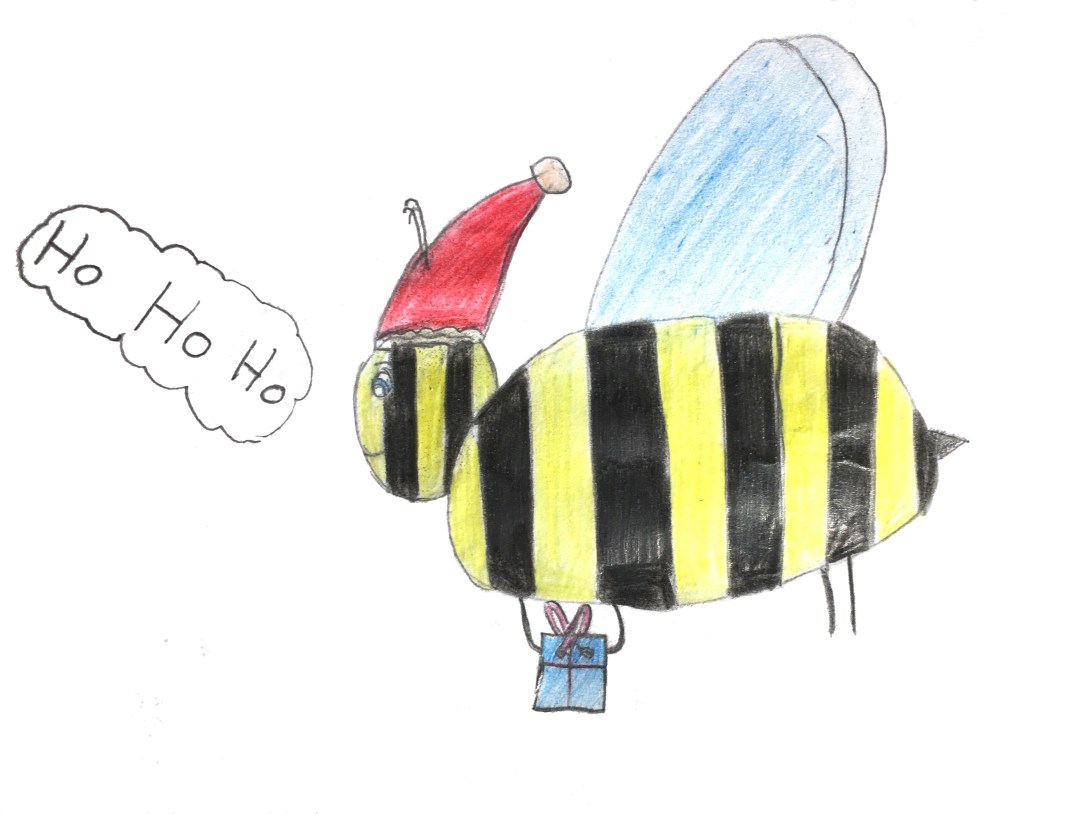
Ha-bee christmas
Ha-bee Christmas (by Emily Phelan)

Urban bees

By Cian White

During Bloom in the Park this summer, I took a break from the Birdwatch Ireland stand to have a gander around and see what was on offer. I wandered into Keeling’s Fruit tent, hoping there would be some Raspberries I could ‘sample’ but was surprised to see the main attraction was a small shoe box sized container. People were huddling around it, some of the children tapping the perspex lid and whooping enthusiastically. Turned out it was a bumble bee colony of the Buff tailed Bumbebee, Bombus terrestris, all higgledy piggily, pots of nectar and pollen strewn about, the untidy cousin of the regimented honey bee, Apis mellifera. These bumblebees are commercially bred to pollinate greenhouse fruits allowing us to buy the most Irish of summer delights; Wexford Strawberries.

With no sign of said fruit to sample and my interest piqued by the commercial hive, I set out to find some of their wild relatives in a garden that had been specifically planted to support bees, the pollinator garden. With 20,000 people at the event that day I wasn’t expecting much, maybe five or six workers of the White tailed bumblebee, Bombus lucorum, the commonest of our bumblebees. In fact, what I found was astonishing, the flowers literally buzzing with hundreds of bees, the red tailed tiny workers of the Early bumblebee (Bombus pratorum) mixing it up with the orange fluff balls of the common carder bee (Bombus pascorum). There were more bumblebees in that one garden than I had seen anywhere else before. In all I counted 6 species of bumble bee in 10m2 of wildflowers, adding Bombus hortorum, Bombus lapidarius and Bombus terrestris, more than a quarter of the 20 bumble bee species in Ireland.

This wasn’t just peculiar just to the Phoenix park. As I cycled home along the dodder later that day, I came across a 100+ strong colony of solitary mining bees, busily excavating their burrows. Another further 100m on and Honey bees swarming a flowering shrub. I was impressed, pollinators seemed to doing well in Dublin.

From Melbourne to Berlin, New York to Vancouver cities are becoming refuges for the beleaguered wild pollinators (Hall et al., 2017). In London, the Olympic Park Meadows show how landscape designers and gardeners are adopting more pollinator friendly planting schemes. In Chicago the Lurie Garden is being hailed as an ‘urban model of responsible horticulture’, with ecological knowledge being utilised to sustainably manage this green roof. The amount of public support for pollinators is pretty astounding; after just two years the orange dots on the map for the Million Pollinator Garden Challenge blots out most of the US, each an action to help conserve pollinators. The All Ireland Pollinator Plan has had enormous buy in which we hope will help halt the decline of Irish pollinators.

But why would we want to conserve pollinators, especially in urban environments? Well, first they are damn adorable – just watch this video. And secondly, they provide us with an important service: pollination. Those apple and pear trees, all the blackberries, strawberries, raspberries, the list goes on, in the gardens and community allotments around Dublin are all pollinated by these incredible insects. The last global estimate of this service was €153 billion (Gallai et al., 2009), but some very exciting research that Dr James Murphy is doing in Prof. Jane Stout’s lab here at Trinity is going to blow that number out of the water (there’ll be a blog post, don’t worry). They provide us with a plethora of tasty fruits, without which society would 100% scientifically collapse (could you imagine no coffee or chocolate?). Joking aside, they do contribute massively to the global economy

But with two thirds of people expected to live in urban areas by 2050, the most important role that pollinators could have in cities is as mascots. They are simultaneously cute and provide an easy to understand ecosystem service, making them the perfect educational tool, an entry point for understanding and appreciating the natural world.

As part of my PhD I hope to investigate Nature-based Solutions. This is a new word for what many people would know as green roofs, constructed wetlands, bioswales or even urban parks. The most famous example would be the High Line in New York. Nature-based Solutions are an alternative to traditional grey infrastructural solutions and have the advantage of delivering many associated benefits such as carbon sequestration, flood mitigation, amenity creation or biodiversity conservation. For example, a green roof planted with native wildflowers can mitigate floods, pull down some carbon, remediate the urban heat island effect and provide a foraging area for pollinators. Imagine a city with a network of green roofs, bioswales, rain gardens, parks and wetlands that supports nature, which in turn help cities to adapt to and mitigate against climate change or pollinator declines. That’s the goal of Bi Urban, a social ecological enterprise based in Stoneybatter whose goal is to create a ‘Lifeline’, an ecological corridor, or to you and me, a nature trail, to connect the royal canal to the Liffey, giving both the residents and the local flora and fauna a place to enjoy and live. There has been a huge movement to start urban beekeeping, with Dublin being very much involved. Bi Urban are already have selections of honey produced in the different districts around Dublin; my personal favourite, the Cabragh variety.

While Nature-based Solutions sound like a panacea for many societal issues, the scientist in me is sceptical. I want evidence that they work, that do what they say on the tin, provide solutions. How much carbon can they sequester, will they mitigate flood damage, can they improve air quality? Connecting Nature, an international consortium headed up by Dr. Marcus Collier here in Trinity, aim to do just that. One common solution to help reverse pollinator declines is the bee hotel. Loved by all as they make us feel like we’re helping the struggling bees. Yet the research, what little of it there is, is not conclusively positive, with bee hotels in Canada helping the spread of invasive bees, and in France only used by two already common bee species. In an informal Facebook poll of Insects and Invertebrates Ireland most of the bee hotels were empty after years of instalment. With only 10 of the 97 species of bee capable of nesting in bee hotels in Ireland, I’d like to investigate whether they are the best way of conserving bee populations and hope to set up an experiment for the coming season.

If you, like me, would like to continue to see a diversity of pollinators in our urban environments we need to provide them with food and shelter. I hope to find out what how to best provide these requirements, so we can enjoy their presence and fruits of their labour, pun intended, for generations to come.

This is all they need, a place to rest and some food, they’ll do the rest 😊


Literature cited:

Baldock, K. C. R., Goddard, M. A., Hicks, D. M., Kunin, W. E., Mitschunas, N., Osgathorpe, L. M., Potts, S. G., Robertson, K. M., Scott, A. V., Stone, G. N., Vaughan, I. P. & Memmott, J. 2015. Where is the UK’s pollinator biodiversity? The importance of urban areas for flower-visiting insects. Proceedings of the Royal Society B-Biological Sciences, 282(1803), pp 10.


Carré, G., Roche, P., Chifflet, R., Morison, N., Bommarco, R., Harrison-Cripps, J., Krewenka, K., Potts, S. G., Roberts, S. P. M., Rodet, G., Settele, J., Steffan-Dewenter, I., Szentgyörgyi, H., Tscheulin, T., Westphal, C., Woyciechowski, M. & Vaissière, B. E. 2009. Landscape context and habitat type as drivers of bee diversity in European annual crops. Agriculture, Ecosystems & Environment, 133(1), pp 40-47.


Gallai, N., Salles, J.-M., Settele, J. & Vaissière, B. E. 2009. Economic valuation of the vulnerability of world agriculture confronted with pollinator decline. Ecological Economics, 68(3), pp 810-821.


Goulson, D., Nicholls, E., Botías, C. & Rotheray, E. L. 2015. Bee declines driven by combined stress from parasites, pesticides, and lack of flowers. Science, 347(6229), pp.


Hall, D. M., Camilo, G. R., Tonietto, R. K., Ollerton, J., Ahrné, K., Arduser, M., Ascher, J. S., Baldock, K. C. R., Fowler, R., Frankie, G., Goulson, D., Gunnarsson, B., Hanley, M. E., Jackson, J. I., Langellotto, G., Lowenstein, D., Minor, E. S., Philpott, S. M., Potts, S. G., Sirohi, M. H., Spevak, E. M., Stone, G. N. & Threlfall, C. G. 2017. The city as a refuge for insect pollinators. Conservation Biology, 31(1), pp 24-29.


Matteson, K. C., Ascher, J. S. & Langellotto, G. A. 2008. Bee Richness and Abundance in New York City Urban Gardens. Annals of the Entomological Society of America, 101(1), pp 140-150.


Cian White is a first-year PhD student in Prof Stout’s lab at Trinity College Dublin, co-supervised by Dr Marcus Collier.

It’s time to appreciate the little things in life

People might not think they are cute or cool, but the world really is a much better place with insects in it.

Nothing brings you back down to earth quite like 11 year olds. I recently asked a group of Dublin school children what they knew about insects – the creatures that, as an entomologist, I have dedicated my entire professional life to studying. The resounding response? “They are ugly!” Nothing about them having six legs, or that they can fly, or even that they are small. No, straight up, ugly.

You can probably imagine my face. Incredulous, dismayed, quickly racking my brains for the facts that might inspire them to look beneath the gnarly exoskeleton and see the amazing, fascinating, brilliant examples of 400 million years of evolution. They are the most diverse animal group on the planet! Over one million described species! Maybe another 20 million un-described species worldwide! Compare that with a measly 10,000 bird species and frankly paltry 5,000 mammal species.

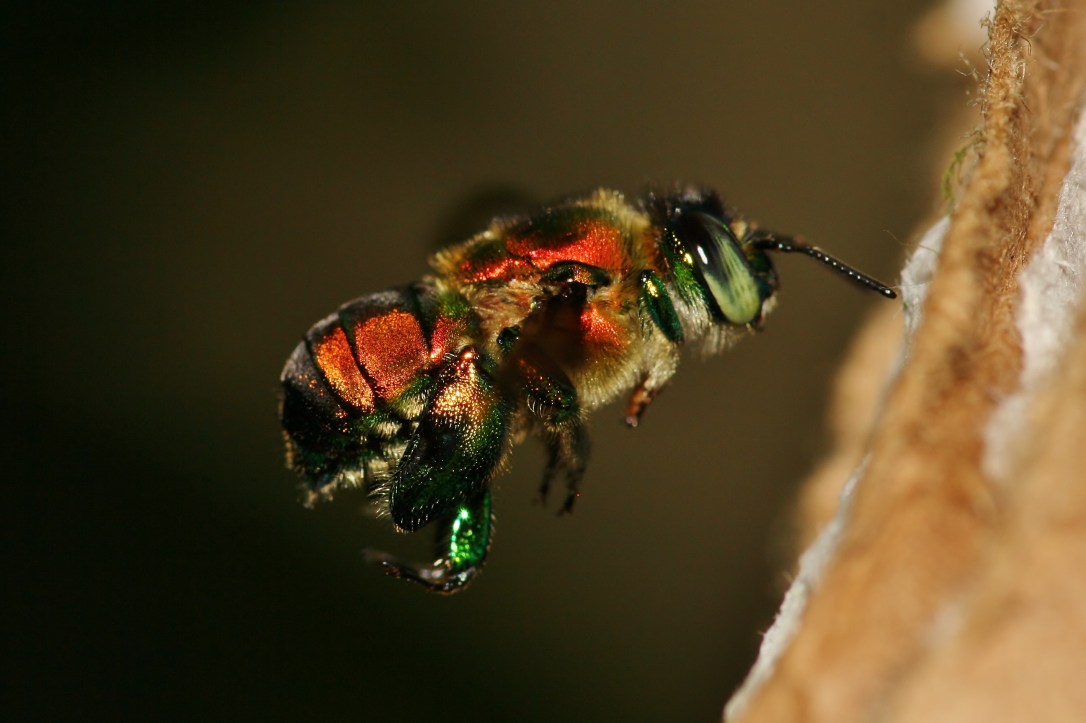
And what about how different they all are? The smallest wasps are so tiny that 10 could fit end to end on a pin head, and the largest stick insects are up to half a meter long! And what about how amazing they are? They can be as loud as a jet engine, produce their own light, farm their own food, and there are about 10 quintillion (that is actually a real number) of them on the planet. And anyway, many of them are beautiful! What about butterflies? Dragonflies? Iridescent rainbow bees?!

euglossine bee Costa Rica Laura Russo
Euglossine bee from Costa Rica (Photo: Laura Russo)

But it made no difference. They were ugly – end of. Insects are not cute. They are not cool. Despite Disney Pixar’s best efforts with A Bug’s Life, insects are facing a branding crisis, a colossal marketing fail. We urgently need to make insects hip. Why? Well, as with pretty much all other living things, far too many of them are under threat.

Recent reports from Germany showed a 75% decline in insect biomass over 25 years, and just last week, a study found a nearly 60% decline in butterflies on English farmland over just 10 years. You may greet this news with a hearty “good riddance”, but the world really is a much better place with insects in it.

Regular readers of this column will know that insects are essential pollinators, providing us with highly nutritious fruits and vegetables, as well as luxuries like chocolate and coffee, cosmetic and pharmaceutical products.

But there’s even more to our six-legged friends than this: silk comes from the cocoon of the silk moth, red food dye from scale insects feeding on cacti, paper is produced from wood pulp in a remarkably similar way to how wasps make their nests. Want to know how long a person has been dead? Ask a forensic entomologist. They can work out how many days it has been since a person died by the sorts of maggots that are present in the decomposing body – different species of fly mature at different rates, and the composition of different species of fly larvae can help identify time of death.

Meyers_b14_s0826a
The Silk Moth. By Bibliographisches Institut, in Leipzig – Meyers Konversations-Lexikon, 4th Auflage, Band 14, Seite 826a (4th ed., Vol. 14, p.826a), Public Domain, https://commons.wikimedia.org/w/index.php?curid=2317808

And if it wasn’t for flies, along with a variety of beetles, who help break down dead plant and animal material, we’d be overrun with animal dung. When cattle were first introduced by European settlers into Australia, people soon realised they also had to introduce dung beetles to get rid of the cow pats. Back home, rat-tailed maggots, actually the larvae of the bee-mimicking drone fly, feed on manure. As they feed, they break down the manure into fragments which can then be recycled by microorganisms to provide nutrients for plant growth. Soil-dwelling insects help to turn the soil, aerating it and distributing nutrients. Ants are particularly good at this job – they can contribute more to soil processing than even earthworms.

Insects are also food for an awful lot of other, more familiar, cuter and cooler animals. Birds and bats catch flying insects on the wing, fish feed on insect larvae in rivers and streams as well as the adults on the surface, and a whole host of land-dwelling animals rely on insects as a source of food – frogs, lizards, armadillos, hedgehogs and shrews, to name just a few.

As you can probably tell, I could go on like this for quite some time. But the point is, beauty is more than skin deep. Insects are awesome and incredibly important in healthy ecosystems. Isn’t it about time we started appreciating the little things?


By Jane Stout

This article originally appeared in The Irish Times 23.11.17