The Teagasc Farmland Biodiversity Group led by Dr Saorla Kavanagh, (Department of Environment, Soils and Land Use, Johnstown Castle) invites applications for a fully funded 4-year PhD. The PhD candidate will be registered at Trinity College Dublin and co-supervised by Professor Jane Stout, Professor of Ecology, School of Natural Sciences.
Project Background and Description Pollinator decline is a key threat to biodiversity conservation and the provision of ecosystem services. One third of Ireland’s bee species are under threat, with intensification and homogenisation of agricultural landscapes considered the principal driver. Diversifying habitats and understanding farmer attitudes towards biodiversity are key to halting further pollinator decline. Semi-natural habitats on the farm, for example, hedgerows, woodlands and trees, and wetland areas including ponds can provide valuable food and nesting resources for pollinators. In Ireland, there is little data on just how valuable ponds are for pollinators. Restoring biodiversity-friendly habitats and designing evidence-based actions that benefit biodiversity on the farm are crucial to meet the requirements of the EU’s Biodiversity Strategy and Nature Restoration Regulation, and to inform Policy for Agri-Environment measures. The aim of this PhD is to identify the benefits of ponds for pollinators, and gain an understanding of farmers’ knowledge of farmland biodiversity. Barriers around implementing biodiversity measures on the farm and solutions to these barriers will be identified.
Candidate Profile The ideal candidate will:
Hold at least an upper second class honours (or equivalent) Bachelor or Masters degree in, entomology, plant science, zoology, environmental science, or another related discipline
Have demonstrable analytical skills in the field and/or laboratory, and in data handling, analysis and presentation
Have the capacity/willingness to think critically and creatively, and apply multidisciplinary techniques to address hypothesis-driven questions
Work well in a multi-disciplinary team, and be able to work independently
Have excellent oral and written communication skills
Be willing to travel to field sites to conduct fieldwork and interact with landowners/farmers
Hold a full clean driving licence and able to drive in Ireland
Meet Trinity postgraduate entry requirements. See English language requirements here.
Funding This is a 4-year PhD project funded by the Teagasc Walsh Scholar Programme and covers an annual stipend of €25,000, and student fees of up to a maximum of €6,000. Project costs will be covered.
Application procedure Please send a CV and a 1-2 page personal statement detailing your interest in the project Tuesday, June 24th 2025 via email to Dr Saorla Kavanagh saorla.kavanagh@teagasc.ie quoting the reference number (2025037) in the subject field. Your CV should include the name and contact details of two references. In your personal statement, please explain both why you are specifically interested in this PhD project and why you are a strong candidate to undertake it. Interviews will take place (online) Friday, July 4th 2025.
Project start date: September 2025 Please send all inquiries to Dr Saorla Kavanagh Saorla.kavanagh@teagasc.ie
Pollinators are an important part of the world’s biodiversity, responsible for pollinating crops and wild plants, providing a valuable ecosystem service (Potts, 2010). Despite its importance, it is evident the global decline of the wild and domesticated species of pollinators (Potts, 2010). In Ireland, 30% of pollinator species are classified as threatened with extinction (Fitzpatrick et al., 2007), which jeopardises the country’s food production since the decline of pollinators means the decline of pollinator-dependent plant species (Potts, 2010).
78% of Europe’s flowering plants benefit from animal pollination, as do 71% of the crops that supply 90% of the world’s food. However, modern agriculture contributes to the decline of pollinator species through the application of agrochemicals and the conversion to highly productive monocultures (Russo et al., 2022). In a country like Ireland, where nearly 70% of land is managed for agriculture, and the agri-food sector is one of the country’s biggest industries, contributing in 2020 with 7% of the country’s gross income, plus 10% of exports (Government of Ireland, 2021), this is a pertinent issue.
Figure 1: Hedgerow managed for pollinators in an arable farm in Kildare.
The decline of bees not only impacts human life with agriculture and food security, but also the entire ecosystem, as without their action, there is a decline in ecosystem services. It means that, for example, wildlife does not have access to fruits and seeds, which interferes with nutrient cycling, seed dispersal and adaptation to climate change (All-Ireland Pollinator Plan, 2021). Furthermore, pollinator conservation has beneficial effects on pest control, soil erosion and microclimate regulation, which helps to mitigate the effects of the climate crisis and biodiversity loss (All-Ireland Pollinator Plan, 2021).
Figure 2: A green-veined butterfly (Pieris napi) on hedgerow Hawthorn (Crateagus monogyna).
According to Russo et al. (2022), it is extremely important to take conservation actions that protect the remaining high-quality habitats and improve the quality of degraded systems by identifying central organisms in the plant-pollinator network that can support the pair’s diversity and abundance.
A key challenge facing biodiversity conservation is human behaviour and the factors that govern its change (Marselle et al., 2020; Schultz, 2011; Knapp et al., 2020). However, Knapp et al. (2020) identified that when developing conservation strategies, natural scientists often disregard social factors affecting the human decision-making process to favour ecological evidence. This is particularly interesting because the implementation of conservation practices is majorly voluntary (Witzling et al., 2021) and, therefore, relies on a human decision.
Ignoring the social aspect of the conservation problem creates a gap between the ecological solutions and the implementation of these solutions by individuals, communities and society in general. This gap demands interdisciplinary approaches combining the understanding of the social pressures and norms that shape behaviour, the psychological reasons behind such behaviours, and the ecological solutions that can improve conservation behaviours.
Farms cover 67.6% of the Ireland’s area (EPA, 2022); therefore, taking into consideration farmers’ experience and knowledge of the land to adapt the already in place actions to a more comprehensive and user-friendly action plan is extremely important for a real impact in not only conserving the pollinators but also reversing the trend and restore pollinators in the country.
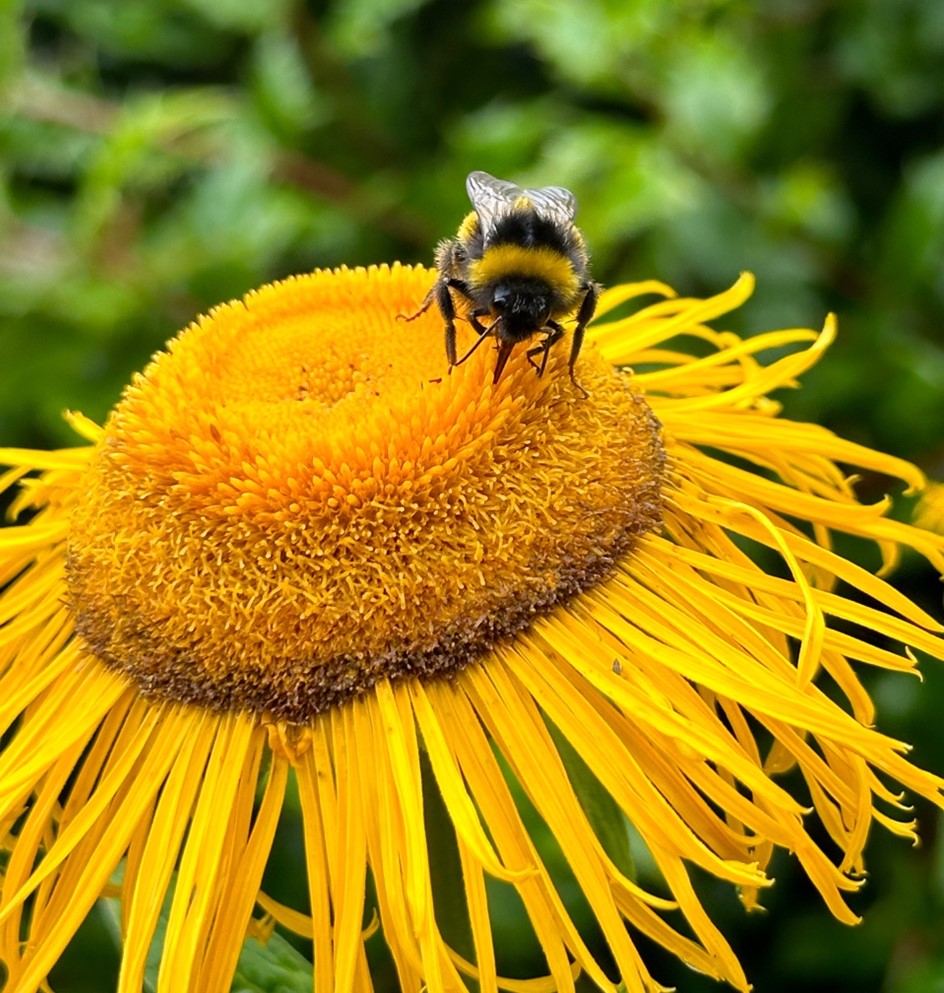
Figure 3: A bumblebee foraging on a Yellow Oxeye (Telekia speciosa).
Ask a Farmer is a PhD research project that will contribute to closing the gap between farmers’ actions and the ecological solutions to reverse pollinator decline using the All-Ireland Pollinator Plan (AIPP) as a case study, expanding the traditional, evidence-based conservation research and increasing the uptake and perpetuation of the AIPP. Adopting a holistic perspective that acknowledges the diverse and plural values individuals and societies attribute to nature (IPBES, 2022), and understanding the wide range of social factors (beyond finance). These social factors shape farmer motivation, capabilities and opportunities, influencing their behaviour around pollinator interventions and policies.
This will be possible by first developing a socio-psychological model to identify and quantify the social factors, including historical context, well-being, finance, social norms and identity, influencing the behaviour of the farmers. Then, the social effectiveness of the pollinator-friendly actions proposed by the AIPP (figure 4) will be tested by evaluating what is being done in real-life farms, integrating the recommendations and the experience of a lifetime in the field. Finally, developing a strategy that integrates social and ecological perspectives to increase the number of farmers adopters of the AIPP, ensuring a continuation of the program and enhancing pollinator conservation in Ireland and beyond.
Figure 4: Five pollinator-friendly actions proposed by the All-Ireland Pollinator Plan.
This May marks the beginning of the 2025 field season, during which the team started visiting the partner farms to collect ecological data on pollinators and interview the farmers about their perspectives on conservation actions, particularly pollinator conservation. A very ‘beezy’ summer ahead!
Figure 5: The team on our first day of the field season 2025. Dr. Sarah Larragy (front), Moya Owens (standing), and Fernanda Azevedo (sitting).
About the author:
Fernanda ‘Fern’ Azevedo is a first-year PhD researcher funded by the Trinity Research Doctorate Award, supervised by Professor Jane Stout, Dr. Jessica Knapp and Dr. Sarah Larragy. Her doctoral research builds on the themes she explored during her MSc in Biodiversity and Conservation at Trinity College Dublin, supervised by Dr. Jessica Knapp.
References:
All-Ireland Pollinator Plan (2021) All-Ireland Pollinator Plan 2021-2025. National Biodiversity Data Centre, Waterford. Available at pollinators.ie (Last accessed on 07/05/2025).
EPA (2022) Ireland’s Environment: Maps and Charts – Key Message 13: Land use.Available at:epa.ie (Last accessed on 07/05/2025).
Fitzpatrick, U., Murray, T.E., Paxton, R.J., Breen, J., Cotton, D., Santorum, V., Brown, M.J.F. (2007) Rarity and decline in bumblebees – A test of causes and correlates in the Irish fauna. Biological Conservation, 136(2): 185-194. DOI: 10.1016/j.biocon.2006.11.012
Government of Ireland (2021) Climate Action Plan 2021: Securing our Future. Dublin. Available at: gov.ie/pdf (Last accessed on 07/05/2025).
IPBES. (2022) Summary for Policymakers of the Methodological Assessment of the Diverse Values and Valuation of Nature of the Intergovernmental Science-Policy Platform on Biodiversity and Ecosystem Services (IPBES). DOI: 10.5281/zenodo.6522392
Knapp, J.L., Phillips, B.B., Clements, J., Shaw, R.F., Osborne, J.L. (2020) Socio-psychological factors, beyond knowledge, predict people’s engagement in pollinator conservation. People and Nature, pp. 204–220. DOI: 10.1002/pan3.10168
Marselle, M.R., Turbe, A., Shwartz, A., Bonn, A., Colléony, A. (2020) Addressing behaviour in pollinator conservation policies to combat the implementation gap. Conservation Biology. Vol 35 (2), 610-622. DOI: 10.1111/cobi.13581
Potts, S.G., Biesmeijer, J.C., Kremen, C., Neumann, P., Schweiger, O., Kunin, W.E. (2010) Global pollinator declines: trends, impacts and drivers. Trends in Ecology & Evolution. Vol.25, 6, 345-353. DOI: 10.1016/j.tree.2010.01.007
Russo, L., Fitzpatrick, Ú., Larkin, M., Mullen, S., Power, E., Stanley, D., White, C., O’Rourke, A., & Stout, J. C. (2022). Conserving diversity in Irish plant–pollinator networks. Ecology and Evolution, 12, e9347. DOI: 10.1002/ece3.9347
Witzling, L., Wald, D., Williams, E. (2021) Communicating with farmers about conservation practices: lessons learned from a systematic review of survey studies. Journal of Soil and Water Conservation. Vol. 76(5), 00145. DOI: 10.2489/jswc.2021.00145
A highly motivated individual is sought to join the multidisciplinary team of ANTENNA “Making technology work for monitoring pollinators”, a European Biodiversa consortium nationally funded by the Environmental Protection Agency. The successful applicant will be based in the School of Natural Sciences at Trinity College Dublin, with Professor Jane Stout, collaborating with partners across Europe.
About the project
Due to pollinators’ decline and their importance in food security and ecosystems, the EU Pollinators Initiative has prioritised the establishment of a comprehensive monitoring system (EU PoMS). Modern technologies like robotics and computer vision can improve pollinator monitoring coverage, speed, and accuracy. However, more research is needed to advance and adapt these technologies to determine the best, most cost-effective ways to use them for pollinator monitoring.
ANTENNA will assess stakeholder needs regarding usability, design, current limitations, and opportunities for improvement to enhance new monitoring methods. Based on this, we will improve methodologies whilst testing their effectiveness and complementarity alongside traditional sampling across various regions within and outside the EU. Additionally, we will create a roadmap for improving pollinator monitoring across Europe using these frameworks, data standards, and integration pipelines.
About the role
We seek an experienced individual to join the team for up to 2 years of the ANTENNA project. This person will be responsible for:
Assessing stakeholder needs for novel pollinator monitoring technologies.
Trialling novel technologies at our site network in Ireland.
Providing a roadmap for novel pollinator monitoring technologies to be incorporated into European policy.
Working with the wider project team to contribute to a cost-benefit analysis and refine methods.
Project management, including reporting, data management, and managing relationships with project personnel and partners
Skills and qualifications required
Essential
Experience in biodiversity monitoring
Exceptional skills in the management of a multi-partner project, including arranging meetings, reporting, and interacting with researchers and a wide range of stakeholders (partners, taxonomic experts, funders, and decision-makers)
Excellent interpersonal and problem-solving skills
Excellent personal time management
Excellent data handling and presentation skills
Excellent report writing skills
Desirable
PhD in ecological/environmental sciences, entomology, biodiversity or similar
Experience with insect identification
Experience in successfully publishing scientific journal articles
Job specifications
Post status: Up to 24 month Specific Purpose Contract
The duration of this contract is limited to the above-fixed term so that the successful candidate can complete work on the ANTENNA project. This contract is, therefore, limited to a fixed term and is not being offered on a permanent basis, as the specific scope of responsibilities associated with this role aligns with the externally funded ANTENNA project timeline and deliverables and is expected to conclude within the period outlined.
Hours of Post: Full-time, 35 hours per week
Salary: This appointment will be made on the Research Assistant (€31,962 – €41,943 per annum) or Post-Doctoral Researcher Salary Scale (€43,908 – €44,496 per annum) at a point depending on experience, in line with current Irish Universities Association University Research Salary Scales/Guidelines.
How to apply
Applicants should submit a Curriculum Vitae and a Cover Letter that specifically addresses their relevant experience and outlines their suitability for the position, along with three referees’ names and contact details, to Jessica Knapp (KNAPPJ@tcd.ie). The position will remain open until filled.
Applicants not addressing the application requirements above will not be considered at the shortlist stage.




 Campus Buzz