Dr Sarah Larragy, post-doctoral researcher working on RestPoll, TCD.
We are making strides on our work as part of the Horizon Europe funded project called “RestPoll” (https://www.restpoll.eu). The name of our project, RestPoll, stands for “Restoring Pollinator habitats across European agricultural landscapes”. Among its 31 partners are both natural and social scientists from research institutions across Europe, alongside professionals from ministries, NGOs and businesses. Our partners represent 14 countries in Europe.
What is the goal of this project?
The mission of this project is to restore and increase connectivity between habitats for pollinators to help reverse the decline of these essential insects and the important pollinating services they provide. It also hopes to investigate co-benefits of pollinator restoration to various sectors of society as well as incentives and barriers (e.g. in policy) to pollinator restoration. In doing this, RestPoll will help fill the necessary knowledge gaps that will help to enable and support members of society to reverse pollinator decline.
How will we do it?
A core part of this project is to establish, in each participating partner country, case study areas that contain ‘living lab’ sites. With this network of living labs established, RestPoll will assess how actions taken to help restore pollinator habitats impact both pollinators and people alike.
| What is a living lab? A living lab is a setting where “experiments, research, and innovation take place in real-life contexts, often involving end-users or stakeholders directly”. |
Aligning with other Irish research:
RestPoll is aligned with, and part of, the Research Ireland-funded BiOrbic Bioeconomy Centre (https://biorbic.com/), specifically the Healthy Ecosystems Challenge. Healthy, functioning, biodiverse ecosystems underpin the bioeconomy, particularly in agricultural landscapes.
In addition, RestPoll is working with the FarmBioNet project https://farmbionet.eu/, which is a Farmer-focused Biodiversity and Agricultural Knowledge Network, which brings together stakeholders for researching, implementing and supporting Biodiversity Friendly Farming practices.
RestPoll Updates so far:
Establishing Irish Case Study Area:
Last summer, I began reaching out to farmers to see about monitoring pollinators on their farms. Many of the farmers had previously been involved in an EIP project called ‘Protecting Farmland Pollinators’ (NBDC, Project Manager Dr Saorla Kavanagh), and so were already taking actions to restore habitats for pollinators on their farms, including reduced hedgerow cutting, reduced pesticide use and having pollinator friendly trees, to name a few.
The summer involved many farm walks and chats over cups of tea with farmers to tell them more about the RestPoll project and, most importantly, to learn more about their perspectives on biodiversity conservation in agriculture. With the help of Research Assistant, Claire Kearney, and Erasmus+ student, Anna-Sonia Anastasiadou, a trial round of pollinator surveys was also carried out.
First Irish RestPoll Living Lab workshop:
In Sept 2024, we ran our first Living Lab workshop on a participating farm site in Athy. Among attendees were farmers, researchers and a representative from DAFM. Attendees received an overview of the RestPoll project and our plans and heard the reflections on the key successes of the Protecting Farmland Pollinators project from Dr Saorla Kavanagh, before delving into discussions around biodiversity conservation in agriculture. A farm walk also took place, led by our host Andrew Bergin, tillage farmer and Farming For Nature Ambassador. For a more detailed summary of this workshop and the discussions that took place, follow this link.
Watch this space…
This year, we will be conducting three rounds of pollinator and floral surveys on participating farms in the Co. Kildare region. Also on our pollinator monitoring team are PhD student Fernanda Azevedo and Moya Owens, research assistant working on the “Antenna” project. Over the summer, we also hope to trial out a rapid assessment tool with some farmers to help RestPoll develop an easy-to-use tool to quickly monitor pollinators. A second living lab workshop is also due to take place this Autumn, where we can update our Living Lab network on our progress.
For more information about RestPoll or if you are interested in getting involved, email Sarah at slarragy@tcd.ie.
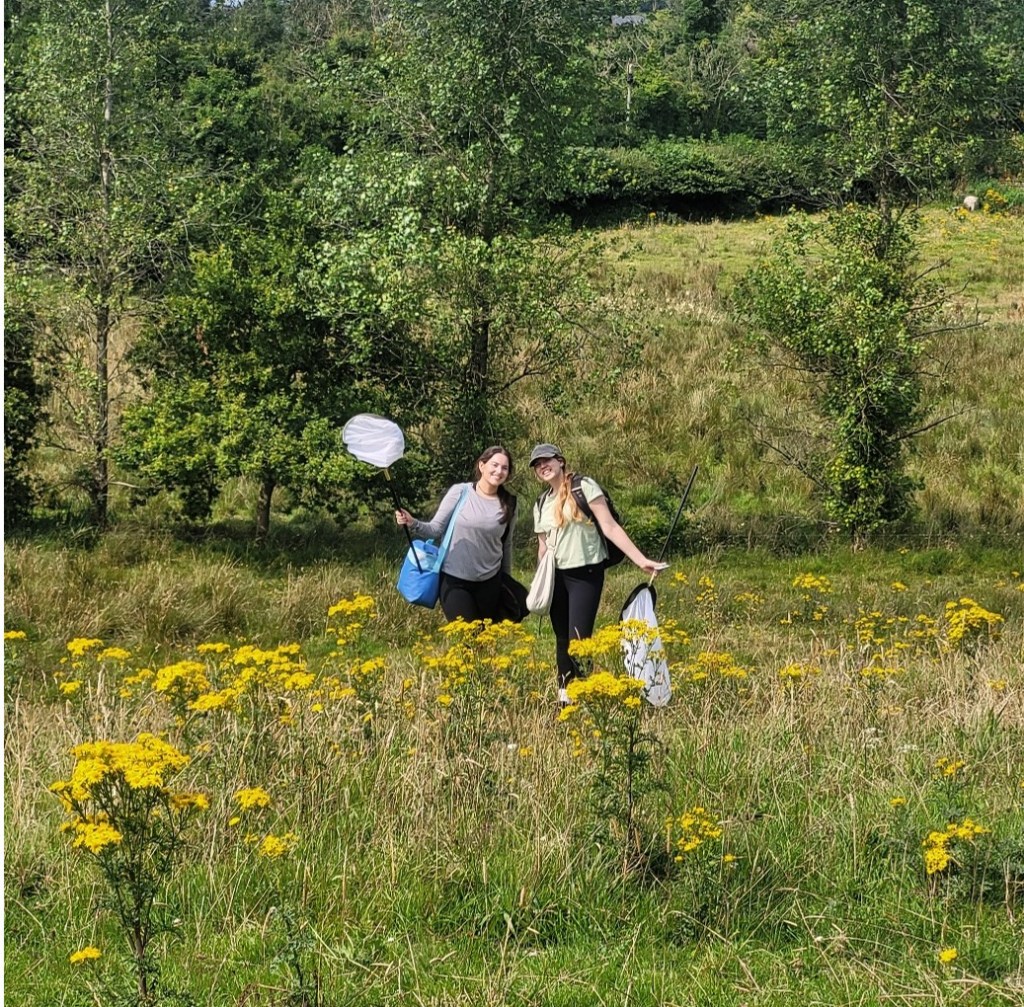
Claire Kearney (L) and Anna-Sonia Anastasiadou (R) happy after a long day of pollinator surveys. August, 2024.

 Campus Buzz